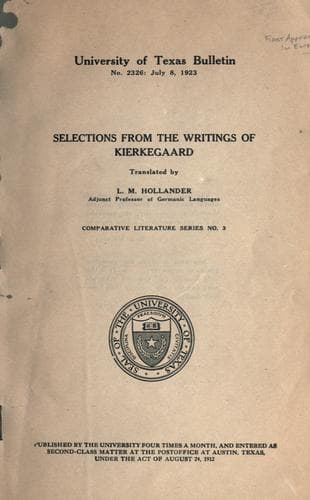
Selections from the Writings of KierkegaardKierkegaard, Søren
Religion
Selections from the Writings of Kierkegaard
Kierkegaard, Søren
Philosophy; Theology
"Come hither!" For he supposes that they that labor and are
heavy laden feel their burden and their labor, and that they
stand there now, perplexed and sighing--one casting about with
his eyes to discover whether there is help in sight anywhere;
another with his eyes fixed on the ground, because he can see
no consolation; and a third with his eyes staring heavenward,
as though help was bound to come from heaven--but all seeking.
Therefore he sayeth: "come hither!" But he invites not him who
has ceased to seek and to sorrow.--"Come hither!" For he who
invites knows that it is a mark of true suffering, if one walks
alone and broods in silent disconsolateness, without courage to
confide in any one, and with even less self-confidence to dare
to hope for help. Alas, not only he whom we read about was possessed
of a dumb devil.[6] No suffering which does not first of all
render the sufferer dumb is of much significance, no more than
the love which does not render one silent; for those sufferers
who run on about their afflictions neither labor nor are heavy
laden. Behold, therefore the inviter will not wait till they
that labor and are heavy laden come to him, but calls them lovingly;
for all his willingness to help might, perhaps, be of no avail
if he did not say these words and thereby take the first step;
for in the call of these words: "come hither unto me!" he comes
himself to them. Ah, human compassion--sometimes, perhaps, it is
indeed praiseworthy self-restraint, sometimes, perhaps, even true
compassion, which may cause you to refrain from questioning him
whom you suppose to be brooding over a hidden affliction; but
also, how often indeed is this compassion but worldly wisdom which
does not care to know too much! Ah, human'compassion--how often
was it not pure curiosity, and not compassion, which prompted
you to venture into the secret of one afflicted; and how burdensome
it was--almost like a punishment of your curiosity--when he
accepted your invitation and came to you! But he who sayeth
these redeeming words "Come hither!" he is not deceiving himself
in saying these words, nor will he deceive you when you come to
him in order to find rest by throwing your burden on him. He
follows the promptings of his heart in saying these words, and
his heart follows his words; if you then follow these words,
they will follow you back again to his heart. This follows as
a matter of course--ah, will you not follow the invitation?--"Come
hither!" For he supposes that they that labor and are heavy
laden are so worn out and overtaxed, and so near swooning that
they have forgotten, as though in a stupor, that there is such
a thing as consolation. Alas, or he knows for sure that there
is no consolation and no help unless it is sought from him; and
therefore must he call out to them "Come hither!"
Public-domain text, read in full here on John Shaqi.
Reviews
Reviews
No reviews yet
Be the first to share your thoughts on this work.
Elsewhere in the archive
Join the Discussion
Join the discussion
Sign in to leave a comment or review.
Sign InorCreate an account