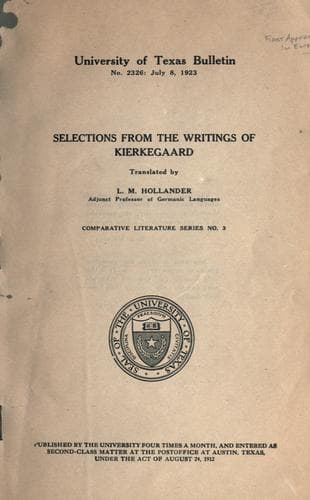
Selections from the Writings of KierkegaardKierkegaard, Søren
Religion
Selections from the Writings of Kierkegaard
Kierkegaard, Søren
Philosophy; Theology
"Come hither!" For is it not so that every society has some
symbol or token which is worn by those who belong to it? When
a young girl is adorned in a certain manner one knows that she
is going to the dance: Come hither all ye that labor and are
heavy laden--come hither! You need not carry an external and
visible badge; come but with your head anointed and your face
washed, if only you labor in your heart and are heavy laden.
"Come hither!" Ah, do not stand still and consider; nay, consider,
consider that with every moment you stand still after having
heard the invitation you will hear the call more faintly and thus
withdraw from it, even though you are standing still.--"Come
hither!" Ah, however weary and faint you be from work, or from
the long, long and yet hitherto fruitless search for help and
salvation, and even though you may feel as if you could not
take one more step, and not wait one more moment, without dropping
to the ground: ah, but this one step and here is rest!--"Come
hither!" But if, alas, there be one who is so wretched that
he cannot come?--Ah, a sigh is sufficient; your mere sighing
or him is also to come hither.
THE PAUSE
COME HITHER UNTO ME ALL YE THAT LABOR AND ARE HEAVY
LADEN, AND I SHALL GIVE YOU REST.
Pause now! But what is there to give pause? That which in the
same instant makes all undergo an absolute change--so that,
instead of seeing an immense throng ofthem that labor and are
heavy laden following the invitation, you will in the end behold
the very opposite, that is, an immense throng of men who flee
back shudderingly, scrambling to get away, trampling all down
before them; so that, if one were to infer the sense of what
had been said from the result it produced, one would have to
infer that the words had been "_procul o procul este profani_,"
rather than "come hither"--that gives pause which is infinitely
more important and infinitely more decisive: THE PERSON OF HIM
WHO INVITES. Not in the sense that he is not the man to do what
he has said, or not God, to keep what he has promised; no, in
a very different sense.
Pause is given by the fact that he who invites is, and insists
on being, the definite historic person he was 1800 years ago,
and that he as this definite person, and living under the conditions
then obtaining, spoke these words of invitation.--He is not, and
does not wish to be, one about whom one may simply know something
from history (i.e. world history, history proper, as against
Sacred History); for from history one cannot "learn" anything
about him, the simple reason being that nothing can be "known"
about him.--He does not wish to be judged in a human way, from
the results of his life; that is, he is and wishes to be, a
rock of offense and the object of faith. To judge him after
the consequences of his life is a blasphemy, for being God, his
life, and the very fact that he was then living and really did
live, is infinitely more important than all the consequences of
it in history.
Public-domain text, read in full here on John Shaqi.
Reviews
Reviews
No reviews yet
Be the first to share your thoughts on this work.
Elsewhere in the archive
Join the Discussion
Join the discussion
Sign in to leave a comment or review.
Sign InorCreate an account