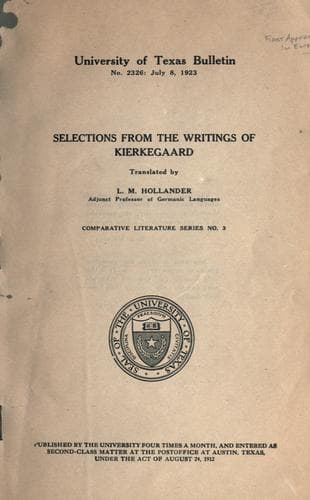
Selections from the Writings of KierkegaardKierkegaard, Søren
Religion
Selections from the Writings of Kierkegaard
Kierkegaard, Søren
Philosophy; Theology
_A_ Who spoke these words of invitation?
He that invites. Who is he? Jesus Christ. Which Jesus Christ?
He that sits in glory on the right side of his Father? No. From
his seat of glory he spoke not a single word. Therefore it is
Jesus Christ in his lowliness, and in the condition of lowliness,
who spoke these words.
Is then Jesus Christ not the same? Yes, verily, he is today, and
was yesterday, and 1800 years ago, the same who abased himself,
assuming the form of a servant--the Jesus Christ who spake these
words of invitation. It is also he who hath said that he would
return again in glory. In his return in glory he is, again, the
same Jesus Christ; but this has not yet come to pass.
Is he then not in glory now? Assuredly, that the Christian believes.
But it was in his lowly condition that he spoke these words; he
did not speak them from his glory. And about his return in glory
nothing can be known, for this can in the strictest sense be a
matter of belief only. But a believer one cannot become except
by having gone to him in his lowly condition--to him, the rock
of offense and the object of faith. In other shape he does not
exist, for only thus did he exist. That he will return in glory
is indeed expected, but can be expected and believed only by him
who believes, and has believed, in him as he was here on earth.
Jesus Christ is, then, the same; yet lived he 1800 years ago in
debasement, and is transfigured only at his return. As yet he
has not returned; therefore he is still the one in lowly guise
about whom we believe that he will return in glory. Whatever he
said and taught, every word he spoke, becomes _eo ipso_ untrue
if we give it the appearance of having been spoken by Christ in
his glory. Nay, he is silent. It is the lowly Christ who speaks.
The space of time between (i.e. between his debasement and his
return in glory) which is at present about 1800 years, and will
possibly become many times 1800--this space of time, or else
what this space of time tries to make of Christ, the worldly
information about him furnished by world history or church history,
as to who Christ was, as to who it was who really spoke these
words--all this does not concern us, is neither here nor there,
but only serves to corrupt our conception of him, arid thereby
renders untrue these words of invitation.
Public-domain text, read in full here on John Shaqi.
Reviews
Reviews
No reviews yet
Be the first to share your thoughts on this work.
Elsewhere in the archive
Join the Discussion
Join the discussion
Sign in to leave a comment or review.
Sign InorCreate an account