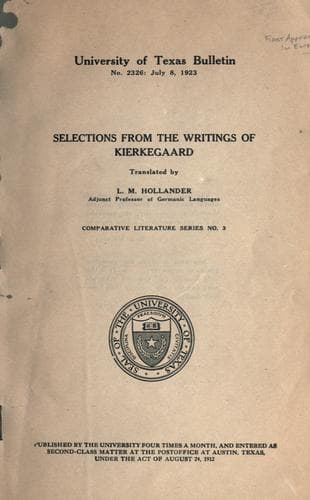
Selections from the Writings of KierkegaardKierkegaard, Søren
Religion
Selections from the Writings of Kierkegaard
Kierkegaard, Søren
Philosophy; Theology
But precisely this is the misfortune, and has been the misfortune,
in Christendom that Christ is neither the one nor the other--neither
the one he was when living on earth, nor he who will return in
glory, but rather one about whom we have learned to know something
in an inadmissible way from history--that he was somebody or other
of great account. In an inadmissible and unlawful way we have
learned to know him; whereas to believe in him is the only permissible
mode of approach. Men have mutually confirmed one another in the
opinion that the sum total of information about him is available
if they but consider the result of his life and the following
1800 years, i.e. the consequences. Gradually, as this became
accepted as the truth, all pith and strength was distilled out
of Christianity; the paradox was relaxed, one became a Christian
without noticing it, without noticing in the least the possibility
of being offended by him. One took over Christ's teachings, turned
them inside out and smoothed them down--he himself guaranteeing
them, of course, the man whose life had had such immense consequences
in history! All became plain as day--very naturally, since Christianity
in this fashion became heathendom.
There is in Christendom an incessant twaddling on Sundays about
the glorious and invaluable truths of Christianity, its mild
consolation. But it is indeed evident that Christ lived 1800
years ago; for the rock of offense and object of faith has become
a most charming fairy-story character, a kind of divine good
old man.[9] People have not the remotest idea of what it means
to be offended by him, and still less, what it means to worship.
The qualities for which Christ is magnified are precisely those
which would have most enraged one, if one had been contemporaneous
with him; whereas now one feels altogether secure, placing implicit
confidence in the result and, relying altogether on the verdict
of history that he was the great man, concludes therefore that
it is correct to do so. That is to say, it is the correct, arid
the noble, and the exalted, and the true, thing--if it is he who
does it; which is to say, again, that one does not in any deeper
sense take the pains to understand what it is he does, and that
one tries even less, to the best of one's ability and with the
help of God, to be like him in acting rightly and nobly, and in
an exalted manner, and truthfully. For, not really fathoming it
in any deeper sense, one may, in the exigency of a contemporaneous
situation, judge him in exactly the opposite way. One is satisfied
with admiring and extolling and is, perhaps, as was said of a
translator who rendered his original word for word and therefore
without making sense, "too conscientious,"--one is, perhaps, also
too cowardly and too weak to wish to understand his real meaning.
Public-domain text, read in full here on John Shaqi.
Reviews
Reviews
No reviews yet
Be the first to share your thoughts on this work.
Elsewhere in the archive
Join the Discussion
Join the discussion
Sign in to leave a comment or review.
Sign InorCreate an account