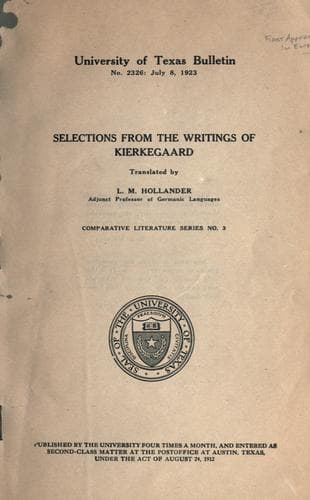
Selections from the Writings of KierkegaardKierkegaard, Søren
Religion
Selections from the Writings of Kierkegaard
Kierkegaard, Søren
Philosophy; Theology
His case is, therefore, not the same as that of a man who, through
the injustice inflicted on him by his times, was not allowed
to be himself or to be valued at his worth, while history revealed
who he was; for Christ himself wished to be abased--it is precisely
this condition which he desired. Therefore, let history not trouble
itself to do him justice, and let us not in impious thoughtlessness
presumptuously imagine that we as a matter of course know who he
was. For that no one knows; and he who believes it must become
contemporaneous with him in his abasement. When God chooses to let
himself be born in lowliness, when he who holds all possibilities
in his hand assumes the form of a humble servant, when he fares
about defenseless, letting people do with him what they list: he
surely knows what he does and why he does it; for it is at all
events he who has power over men, and not men who have power
over him--so let not history be so impertinent as to wish to
reveal who he was.
Lastly--ah the blasphemy!--if one should presume to say that
the percussion which Christ suffered expresses something accidental!
If a man is persecuted by his generation it does not follow
that he has the right to say that this would happen to him in
every age. Insofar there is reason in what posterity says about
letting bygones be bygones. But it is different with Christ!
It is not he who by letting himself be born, and by appearing
in Palestine, is being examined by history; but it is he who
examines, his life is the examination, not only of that generation,
but of mankind. Woe unto the generation that would presumptuously
dare to say: "let bygones be bygones, and forget what he suffered,
for history has now revealed who he was and has done justice by him."
If one assumes that history is really able to do this, then
the abasement of Christ bears an accidental relation to him;
that is to say, he thereby is made a man, an extraordinary man
to whom this happened through the wickedness of that generation--a
fate which he was far from wishing to suffer, for he would gladly
(as is human) have become a great man; whereas Christ voluntarily
chose to be the lowly one and, although it was his purpose to
save the world, wished also to give expression to what the "truth"
suffered then, and must suffer in every generation. But if this
is his strongest desire, and if he will show himself in his
glory only at his return, and if he has not returned as yet;
and if no generation may be without repentance, but on the contrary
every generation must consider itself a partner in the guilt of
that generation: then woe to him who presumes to deprive him of
his lowliness, or to cause what he suffered to be forgotten, and
to clothe him in the fabled human glory of the historic consequences
of his life, which is neither here nor there.
_F_ The Misfortune of Christendom
Public-domain text, read in full here on John Shaqi.
Reviews
Reviews
No reviews yet
Be the first to share your thoughts on this work.
Elsewhere in the archive
Join the Discussion
Join the discussion
Sign in to leave a comment or review.
Sign InorCreate an account