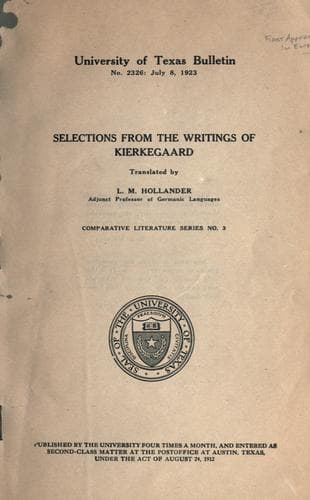
Selections from the Writings of KierkegaardKierkegaard, Søren
Religion
Selections from the Writings of Kierkegaard
Kierkegaard, Søren
Philosophy; Theology
it? No, not a red cent--he has not a red cent to his name, and
if he did he would forthwith give it away. Does he, then, aspire
to a position of honor and dignity in the state? On the contrary,
he loathes all worldly honor. And he who, as I said, condemns
all worldly honor, and practices the art of living on nothing;
he who, if any one, seems best fitted to pass his life in a most
comfortable _dolce far niente_--which is not such a bad thing--:
he lives under a greater strain than any government official who
is rewarded by honor and dignity, lives under a greater strain
than any business man who earns money like sand. Why does he
exert himself thus, or (why this question about a matter not
open to question?) why should any one exert himself thus--in
order to attain to the happiness of being ridiculed, mocked,
and so forth? To be sure, a peculiar kind of pleasure! That one
should push one's way through a crowd to reach the spot where
money, honor, and glory are distributed--why, that is perfectly
understandable; but to push forward to be whipped: how exalted,
how Christian, how stupid!"
Or he will reason as follows: "One hears so many rash opinions
about this person from people who understand nothing--and worship
him; and so many severe condemnations of him by those who, perhaps,
misunderstand him after all. As for me, I am not going to allow
myself to be accused of venturing a hasty opinion. I shall keep
entirely cool and calm; in fact, which counts for still more, I
am conscious of being as reasonable and moderate with him as is
possible. Grant now--which, to be sure. I do only to a certain
extent--grant even that one's reason is impressed by this person.
What, then, is my opinion about him? My opinion is, that for the
present, I can form no opinion about him. I do not mean about his
claim of being God; for about that I can never in all eternity
have an opinion. No, I mean about him as a man. Only by the
consequences of his life shall we be able to decide whether
he was an extraordinary person or whether, deceived by his imagination,
he applied too high a standard, not only to himself, but also to
humanity in general. More I cannot do for him, try as I may--if
he were my only friend, my own child, I could not judge him more
leniently, nor differently, either. It follows from this, to be
sure, that in all probability, and for good reasons, I shall
not ever be able to have any opinion about him. For in order to
be able to form an opinion I must first see the consequences of
his life, including his very last moments; that is, he must be
dead. Then, and perhaps not even then, may I form an opinion of
him. And even granting this, it is not really an opinion about
him, for he is then no more. No more is needed to say why it is
impossible for me to join him while he is living. The authority
he is said to show in his teaching can have no decisive influence
in my case; for it is surely easy to see that his thought moves
in a circle.
Public-domain text, read in full here on John Shaqi.
Reviews
Reviews
No reviews yet
Be the first to share your thoughts on this work.
Elsewhere in the archive
Join the Discussion
Join the discussion
Sign in to leave a comment or review.
Sign InorCreate an account