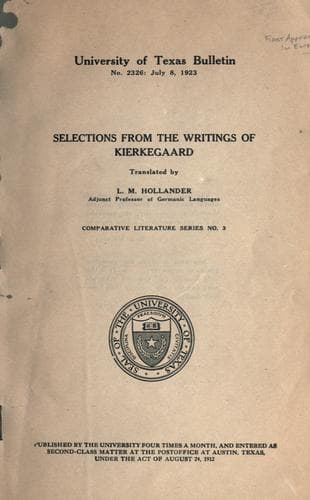
Selections from the Writings of KierkegaardKierkegaard, Søren
Religion
Selections from the Writings of Kierkegaard
Kierkegaard, Søren
Philosophy; Theology
He quotes as authority that which he is to prove,
which in its turn can be proved only by the consequences of his
life; provided, of course, it is not connected with that fixed
idea of his about being God, because if it is therefore he has
this authority (because he is God) the answer must be: yes--if!
So much, however, I may admit, that if I could imagine myself
self living in some later age, and if the consequences of his
life as shown in history had made it plain that he was the extraordinary
person he in a former age claimed to be, then it might very well
be--in fact, I might come very near, becoming his disciple."
An ecclesiastic would reason as follows: "For an impostor and
demagogue he has, to say the truth, a remarkable air of honesty
about him; for which reason he cannot be so absolutely dangerous,
either, even though the situation looks dangerous enough while
the squall is at its height, and even though the situation looks
dangerous enough with his enormous popularity--until the squall
has passed over and the people--yes, precisely the people--overthrow
him again. The honest thing about him is his claim to be the
Messiah when he resembles him so little as he does. That is honest,
just as if some one in preparing bogus paper-money made the bills
so poorly that every one who knows the least about it cannot fail
to detect the fraud.--True enough, we all look forward to a
Messiah, but surely no one with any sense expects God himself
to come, and every religious person shudders at the blasphemous
attitude of this person. We look forward to a Messiah, we are all
agreed on that. But the governance of the world does not go forward
tumultuously, by leaps and bounds; the development of the world,
as is indicated by the very fact that it is a development, proceeds
by evolution, not by revolution. The true Messiah will therefore
look quite different, and will arrive as the most glorious flower,
and the highest development, of that which already exists. Thus
will the true Messiah come, and he will proceed in an entirely
different fashion: he will recognize the existing order as the
basis of things, he will summon all the clergy to council and
present to them the results accomplished by him, as well as his
credentials--and then, if he obtain the majority of the votes
when the ballot is cast, he will be received and saluted as the
extraordinary person, as the one he is: the Messiah.[14]
Public-domain text, read in full here on John Shaqi.
Reviews
Reviews
No reviews yet
Be the first to share your thoughts on this work.
Elsewhere in the archive
Join the Discussion
Join the discussion
Sign in to leave a comment or review.
Sign InorCreate an account