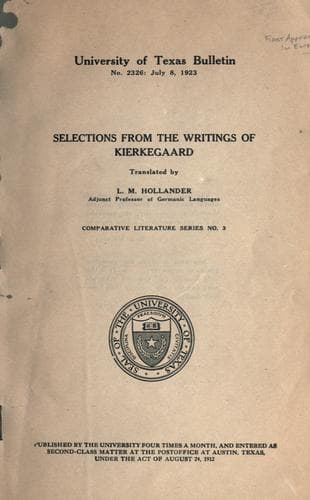
Selections from the Writings of KierkegaardKierkegaard, Søren
Religion
Selections from the Writings of Kierkegaard
Kierkegaard, Søren
Philosophy; Theology
"However, there is a duplicity in this man's behavior; he assumes
too much the role of judge. It seems as if he wished to be, at
one and the same time, both the judge who passes sentence on the
existing order of things, and the Messiah. If he does not wish
to play the role of the judge, then why his absolute isolation,
his keeping at a distance from all which has to do with the
existing order of things? And if he does not wish to be the
judge, then why his fantastic flight from reality to join the
ignorant crowd, then why with the haughtiness of a revolutionary
does he despise all the intelligence and efficiency to be found
in the existing order of things? And why does he begin afresh
altogether, and absolutely from the bottom up, by the help of--fishermen
and artisans? May not the fact that he is an illegitimate child
fitly characterize his entire relation to the existing order
of things? On the other hand, if he wishes to be only the Messiah,
why then his warning about putting a piece of new cloth unto an
old garment.[15] For these words are precisely the watchwords
of every revolution since they are expressive of a person's
discontent with the existing order and of his wish to destroy
it. That is, these words reveal his desire to remove existing
conditions, rather than to build on them and better them, if
one is a reformer, or to develop them to their highest possibility,
if one is indeed the Messiah. This is duplicity. In fact, it is
not feasible to be both judge and Messiah. Such duplicity will
surely result in his downfall.[16] The climax in the life of a
judge is his death by violence, and so the poet pictures it
correctly; but the climax in the life of the Messiah cannot
possibly be his death. Or else, by that very fact, he would
not be the Messiah, that is, he whom the existing order expects
in order to deify him. This duplicity has not as yet been recognized
by the people, who see in him their Messiah; but the existing
order of things cannot by any manner of means recognize him as
such. The people, the idle and loafing crowd, can do so only
because they represent nothing less than the existing order
of things. But as soon as the duplicity becomes evident to them,
his doom is sealed. Why, in this respect his predecessor was
a far more definitely marked personality, for he was but one
thing, the judge. But what confusion and thoughtlessness, to wish
to be both, and what still worse confusion, to acknowledge his
predecessor as the judge--that is, in other words, precisely to
make the existing order of things receptive and ripe for the
Messiah who is to come after the judge, and yet not wish to
associate himself with the existing order of things!"
Public-domain text, read in full here on John Shaqi.
Reviews
Reviews
No reviews yet
Be the first to share your thoughts on this work.
Elsewhere in the archive
Join the Discussion
Join the discussion
Sign in to leave a comment or review.
Sign InorCreate an account