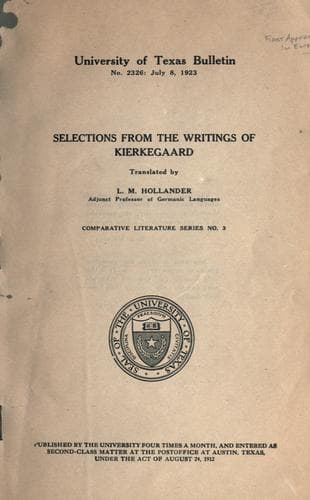
Selections from the Writings of KierkegaardKierkegaard, Søren
Religion
Selections from the Writings of Kierkegaard
Kierkegaard, Søren
Philosophy; Theology
The invitation is surely inviting enough. How, then, shall one
explain the bad relation which did exist, this terribly wrong
relation, that no one, or practically no one, accepted the invitation;
that, on the contrary, all, or practically all--alas! and was
it not precisely all who were invited?--that practically all
were at one in offering resistance to the inviter, in wishing
to put him to death, and in setting a punishment on accepting
aid from him? Should one not expect that after an invitation
such as he issued all, all who suffered, would come crowding
to him, and that all they who were not suffering would crowd
to him, touched by the thought of such compassion and mercy,
and that thus the whole race would be at one in admiring and
extolling the inviter? How is the opposite to be explained?
For that this was the outcome is certain enough; and the fact
that it all happened in those remote times is surely no proof
that the generation then living was worse than other generations!
How could any one be so thoughtless as to believe that? For
whoever gives any thought to the matter will easily see that
it happened in that generation only because they chanced to
be contemporaneous with him. How then explain that it happened--that
all came to that terribly wrong end, so opposite to what ought
to have been expected?
Well, in the first place, if the inviter had looked the figure
which purely human compassion would have him be; and, in the
second place, if he had entertained the purely human conception
of what constitutes man's misery--why, then it would probably
not have happened.
In the first place: According to this human conception of him
he should have been a most generous and sympathetic person, and
at the same time possessed of all qualifications requisite for
being able to help in all troubles of this world, ennobling the
help thus extended by a profound and heartfelt human compassion.
Withal (so they would imagine him) he should also have been a
man of some distinction and not without a certain amount of
human self-assertion--the consequence of which would be, however,
that he would neither have been able, in his compassion, to
reach down to all sufferers, nor yet to have comprehended fully
what constitutes the misery of man and of mankind.
But divine compassion, the infinite unconcern which takes thought
only of those that suffer, and not in the least of one's self,
and which with absolute unconcern takes thought of all that suffer:
that will always seem to men only a kind of madness, and they will
ever be puzzled whether to laugh or to weep about it. Even if
nothing else had militated against the inviter, this alone would
have been sufficient to make his lot hard in the world.
Public-domain text, read in full here on John Shaqi.
Reviews
Reviews
No reviews yet
Be the first to share your thoughts on this work.
Elsewhere in the archive
Join the Discussion
Join the discussion
Sign in to leave a comment or review.
Sign InorCreate an account