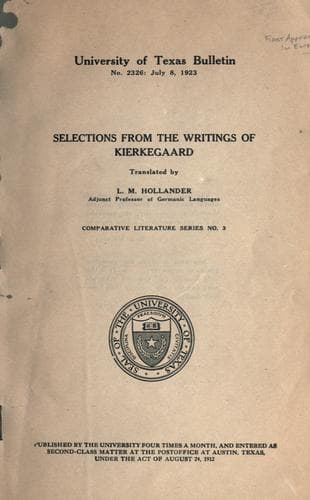
Selections from the Writings of KierkegaardKierkegaard, Søren
Religion
Selections from the Writings of Kierkegaard
Kierkegaard, Søren
Philosophy; Theology
Let a man but try a little while to practice divine compassion,
that is, to be somewhat unconcerned in his compassion, and you
will at once perceive what the opinion of mankind would be.
For example: let one who could occupy some higher rank in society,
let him not (preserving all the while the distinction of his
position) lavishly give to the poor, and philanthropically (i.e.
in a superior fashion) visit the poor and the sick and the wretched--no,
let him give up altogether the distinction of his position and
in all earnest choose the company of the poor and the lowly,
let him live altogether with the people, with workmen, hodmen,
mortar-mixers, and the like! Ah, in a quiet moment, when not
actually beholding him, most of us will be moved to tears by
the mere thought of it; but no sooner would they see him in
this company--him who might have attained to honor and dignity
in the world--see him walking along in such goodly company,
with a bricklayer's apprentice on his right side and a cobbler's
boy on his left, but--well, what then? First they would devise
a thousand explanations to explain that it is because of queer
notions, or obstinacy, or pride, or vanity that he chooses this
mode of life. And even if they would refrain from attributing
to him these evil motives they will never be reconciled with
the sight of him--in this company. The noblest person in the
world will be tempted to laugh, the moment he sees it.
And if all the clergymen in the world, whether in velvet or
in silk or in broadcloth or in satin, contradicted me I would
say: "You lie, you only deceive people with your Sunday sermons.
Because it will always be possible for a contemporary to say
about one so compassionate (who, it is to be kept in mind, is
our contemporary): I believe he is actuated by vanity, and
that is why I laugh and mock at him; but if he were truly compassionate,
or had I been contemporary with him, the noble one--why then!"
And now, as to those exalted ones "who were not understood by
men"--to speak in the fashion of the usual run of sermons--why,
sure enough, they are dead. In this fashion these people succeed
in playing hide and seek. You simply assume that every contemporary
who ventures out so far is actuated only by vanity; and as to
the departed, you assume that they are dead and that they, therefore,
were among the glorious ones.
Public-domain text, read in full here on John Shaqi.
Reviews
Reviews
No reviews yet
Be the first to share your thoughts on this work.
Elsewhere in the archive
Join the Discussion
Join the discussion
Sign in to leave a comment or review.
Sign InorCreate an account