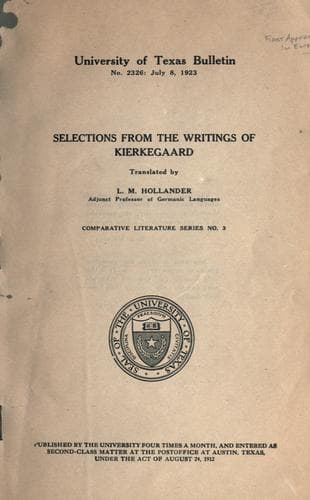
Selections from the Writings of KierkegaardKierkegaard, Søren
Religion
Selections from the Writings of Kierkegaard
Kierkegaard, Søren
Philosophy; Theology
With its invitation to all "that labor and are heavy laden" Christianity
has entered the world, not--as the clergy whimperingly and falsely
introduce it--as a shining paragon of mild grounds of consolation;
but as the absolute. God wills it so because of His love, but it
is God who wills it, and He wills it as He wills it. He does not
choose to have His nature changed by man and become a nice, that
is to say, humane, God; but He chooses to change the nature
of man because of His love for them. Neither does He care to
hear any human impertinence concerning the why and wherefore
of Christianity, and why it entered the world: it is, and is
to be, the absolute. Therefore all the relative explanations
which may have been ventured as to its why and wherefore are
entirely beside the point. Possibly, these explanations were
suggested by a kind of human compassion which believes it necessary
to haggle a bit--God very likely does not know the nature of
man very well, His demands are a bit exorbitant, and therefore
the clergymen must haggle and beat Him down a bit.[24] Maybe
the clergy hit upon that idea in order to stand well with men
and reap some advantage from preaching the gospel; for if its
demands are reduced to the purely human, to the demands which
arise in man's heart, why, then men will of course think well
of it, and of course also of the amiable preacher who knows
how to make Christianity so mild--if the Apostles had been able
to do that the world would have esteemed them highly also in
their time. However, all this is the absolute. But what is it
good for, then--is it not a downright torment? Why, yes, you
may say so: from the standpoint of the relative, the absolute
is the greatest torment. In his dull, languid, sluggish moments,
when man is dominated by his sensual nature, Christianity is
an absurdity to him since it is not commensurable with any definite
"wherefore?" But of what use is it, then? Answer: peace! it is
the absolute. And thus it must be represented; that is, in a
fashion which makes it appear as an absurdity to the sensual
nature of man. And therefore is it, ah, so true and, in still
another sense, so true when the worldly-wise man who is contemporaneous
with Christ condemns him with the words: "he is literally nothing"--quite
true, for he is the absolute. And, being absolute, Christianity
has come in the world, not as a consolation in the human sense:
in fact, quite on the contrary, it is ever reminding one how
the Christian must suffer in order to become, or to remain, a
Christian--sufferings which he may, if you please, escape by
not electing to be a Christian.
Public-domain text, read in full here on John Shaqi.
Reviews
Reviews
No reviews yet
Be the first to share your thoughts on this work.
Elsewhere in the archive
Join the Discussion
Join the discussion
Sign in to leave a comment or review.
Sign InorCreate an account