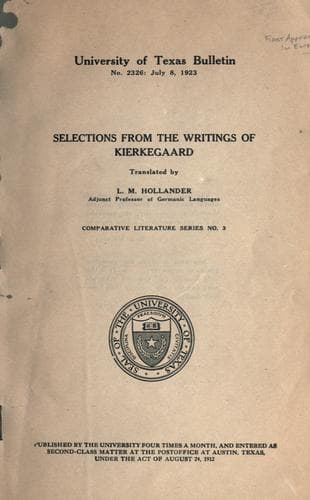
Selections from the Writings of KierkegaardKierkegaard, Søren
Religion
Selections from the Writings of Kierkegaard
Kierkegaard, Søren
Philosophy; Theology
There is, indeed, an unbridgeable gulf fixed between God and
man. It therefore became plain to those contemporary with Christ
that the process of becoming a Christian (that is, being changed
into the likeness of God) is, in a human sense, a greater torment
and wretchedness and pain than the greatest conceivable human
suffering, and moreover a crime in the eyes of one's contemporaries.
And thus will it always be; that is, if becoming a Christian in
reality means becoming contemporaneous with Christ. And if becoming
a Christian does not have that meaning, then all your chatter
about becoming a Christian is a vanity, a delusion and a snare,
and likewise a blasphemy and a sin against the Holy Ghost.
For with regard to the absolute there is but one time, viz. the
present. He who is not contemporaneous with the absolute, for
him it does not exist at all. And since Christ is the absolute,
it is evident that in respect of him there is but one situation:
contemporaneousness. The three, or seven, or fifteen, or seventeen,
or eighteen hundred years which have elapsed since his death do
not make the least difference, one way or the other. They neither
change him nor reveal, either, who he was; for his real nature
is revealed only to faith.
Christ, let me say so with the utmost seriousness, is not an
actor; neither is he a merely historical personage since, being
the paradox, he is an extremely unhistorical personage. But
precisely this is the difference between poetry and reality:
contemporaneousness.[25] The difference between poetry and history
is no doubt this, that history is what has really happened, and
poetry, what is possible, the action which is supposed to have
taken place, the life which has taken form in the poet's imagination.
But that which really happened (the past) is not necessarily
reality, except in a certain sense, viz., in contrast with poetry.
There is still lacking in it the criterion of truth (as inwardness)
and of all religion, there is still lacking the criterion: the
truth FOR YOU. That which is past is not a reality--for me,
but only my time is. That which you are contemporaneous with,
that is reality--for you. Thus every person has the choice to
be contemporaneous with the age in which he is living--and also
with one other period, with that of Christ's life here on earth;
for Christ's life on earth, or Sacred History, stands by itself,
outside of history.
Public-domain text, read in full here on John Shaqi.
Reviews
Reviews
No reviews yet
Be the first to share your thoughts on this work.
Elsewhere in the archive
Join the Discussion
Join the discussion
Sign in to leave a comment or review.
Sign InorCreate an account