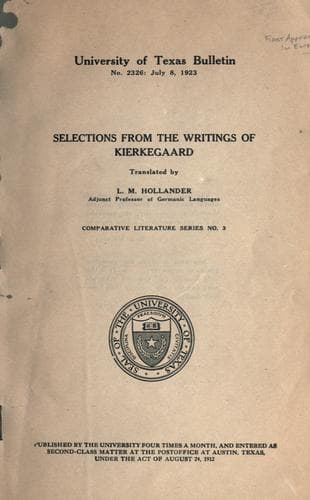
Selections from the Writings of KierkegaardKierkegaard, Søren
Religion
Selections from the Writings of Kierkegaard
Kierkegaard, Søren
Philosophy; Theology
But sin, or the fact that you and I, individually, are sinners,
has at present either been done away with, or else the demands
have been lowered in an unjustifiable manner, both in life--the
domestic, the civic, as well as the ecclesiastic--and in science
which has invented the new doctrine of sin in general. As an
equivalent, one has hit upon the device of helping men into
Christianity, and keeping them in it, by the aid of a knowledge
of world-historic events, of that mild teaching, the exalted
and profound spirit of it, about Christ as a friend, etc., etc.--all
of which Luther would have called stuff and nonsense and which
is really blasphemy, aiming as it does at fraternizing impudently
with God and with Christ.
Only the consciousness of being a sinner can inspire one with
absolute respect for Christianity. And just because Christianity
demands absolute respect it must and shall, to any other way of
looking at it, seem absurdity or terror; just because only thereby
can the qualitative and absolute emphasis fall on the fact that
it is only the consciousness of being a sinner which will procure
entrance into it, and at the same time give the vision which,
being absolute respect, enables one to see the mildness and love
and compassion of Christianity.
The poor in spirit who acknowledge themselves to be sinners,
they do not need to know the least thing about the difficulties
which appear when one is neither simple nor humble-minded. But
when this humble consciousness of one's self, i. e., the individual's,
being a sinner is lacking--aye, even though one possessed all
human ingenuity and wisdom, and had all accomplishments possible
to man: it will profit him little. Christianity will in the same
degree rise terrifying before him and transform itself into
absurdity or terror; until he learns, either to renounce it,
or else, by the help of what is nothing less than scientific
propædeutics, apologetics, etc., that is, through the torments
of a contrite heart, to enter into Christianity by the narrow
path, through the consciousness of sin.
[Footnote 1: First Part; comprising about one-fourth of the whole book.]
[Footnote 2: I. e. Christ; _cf._ Introduction for the use of small
letters.]
[Footnote 3: Socrates.]
[Footnote 4: John I, 1.]
[Footnote 5: Matthew 20, 15.]
[Footnote 6: Luke 11, 14.]
[Footnote 7: Kierkegaard's note: by history we mean here profane history,
world history, history as such, as against Sacred History.]
[Footnote 8: _Cf._ the claim of the Pharisees, Matth. 23, 30: "If we
had been in the days of our fathers, we would not have been partakers
with them in the blood of the prophets."]
[Footnote 9: One is here irresistibly reminded of passages in Ibsen's
"Brand," e. g., Brand's conversation with Einar, in Act I. _Cf._ also
"The invitation and the inviter" and Introduction]
[Footnote 10: Matthew 11, 6.]
[Footnote 11: Luke 18, 32.]
[Footnote 12: Matthew 20, 27f.]
Public-domain text, read in full here on John Shaqi.
Reviews
Reviews
No reviews yet
Be the first to share your thoughts on this work.
Elsewhere in the archive
Join the Discussion
Join the discussion
Sign in to leave a comment or review.
Sign InorCreate an account