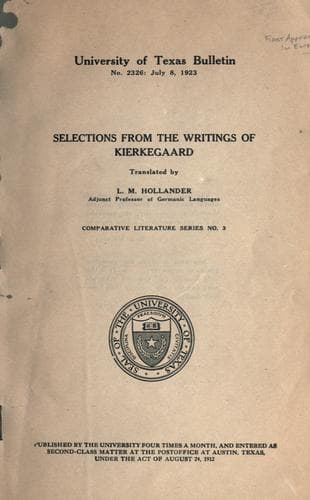
Selections from the Writings of KierkegaardKierkegaard, Søren
Religion
Selections from the Writings of Kierkegaard
Kierkegaard, Søren
Philosophy; Theology
[Footnote 13: The original here does not agree with the sense of the
passage.]
[Footnote 14: Björnson's play of "Beyond Human Power," Part I, Act 2,
reads like an elaboration of these views.]
[Footnote 15: Matthew 9, 16.]
[Footnote 16: The following passage is capable of different
interpretations in the original.]
[Footnote 17: Matthew 14, 17.]
[Footnote 18: _Cf._ 1 Cor. 2, 9.]
[Footnote 19: John 3, 1f.]
[Footnote 20: Luke 23, 35.]
[Footnote 21: John 2, 4, etc.]
[Footnote 22: The passage is not quite clear. Probably, you will not be
the man to explain this phenomenon in the very opposite terms, viz., as
the divinity himself.]
[Footnote 23: Here, the unreserved identification with human suffering
above referred to.]
[Footnote 24: _Cf._ Footnote 8, in "The Misfortune of Christendom."]
[Footnote 25: As my friend, H. M. Jones, points out, the following passage
is essentially Aristotelian: "The true difference is that one (history)
relates what has happened, the other (poetry) what may happen";
"Poetics," Chap. IX.]
[Footnote 26: _Cf._ Plato's "Apologia" where Socrates is made to say of
himself that he is inflicted on the Athenians like a gadfly on a horse,
in order to keep them awake.]
[Footnote 27: Luke 10, 23.]
[Footnote 28: Kierkegaard's own note.]
THE PRESENT MOMENT[1]
BY WAY OF INTRODUCTION
(No. I, 1)
Plato says somewhere in his "Republic" that things will go well
only when those men shall govern the state who do not desire to
govern. The idea is probably that, assuming the necessary capability,
a man's reluctance to govern affords a good guarantee that he
will govern well and efficiently; whereas a man desirous of
governing may very easily either abuse his power and become
a tyrant, or by his desire to govern be brought into an unforeseen
situation of dependence on the people he is to rule, so that
his government really becomes an illusion.
This observation applies also to other relations where much
depends on taking things seriously: assuming there is ability
in a man, it is best that he show reluctance to meddle with
them. To be sure, as the proverb has it: "where there is a will
there is a way"; but true seriousness appears only when a man
fully equal to his task is forced, against his will, to undertake
it--against his will, but fully equal to the task.
In this sense I may say of myself that I bear a correct relation
to the task in hand: to work in the present moment; for God knows
that nothing is more distasteful to me.
Public-domain text, read in full here on John Shaqi.
Reviews
Reviews
No reviews yet
Be the first to share your thoughts on this work.
Elsewhere in the archive
Join the Discussion
Join the discussion
Sign in to leave a comment or review.
Sign InorCreate an account