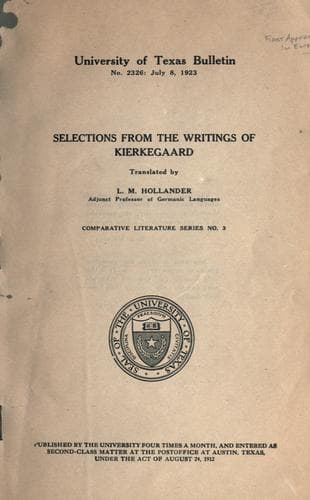
Selections from the Writings of KierkegaardKierkegaard, Søren
Religion
Selections from the Writings of Kierkegaard
Kierkegaard, Søren
Philosophy; Theology
Thus in matters of the spirit, and likewise in matters of religion.
History has frequently been compared to what the chemists call
a "process." The figure is quite suggestive, providing it is
correctly understood. For instance, in the "process of filtration"
water is run through a filter and by this process loses its
impurities. In a totally different sense history is a process.
The idea is given utterance--and then enters into the process
of history. But unfortunately this process (how ridiculous a
supposition!) consists not in purifying the idea, which never
is purer than at its inception; oh no, it consists in gradually
and increasingly botching, bungling, and making a mess of, the
idea, in using up the idea, in--indeed, is not this the opposite
of filtering?--adding the impurer elements which it originally
lacked: until at last, by the enthusiastic and mutually appreciative
efforts of successive generations, the idea has absolutely disappeared
and the very opposite of the original idea is now called the
idea, which is then asserted to have arisen through a historic
process by which the idea is purified and elevated.
When finally the right man arrives, he who in the highest sense
is called to the task--for all we know, chosen early and slowly
educated for this business--which is, to throw light on the matter,
to set fire to this jungle which is a refuge for all kinds of
foolish talk and delusions and rascally tricks--when he comes
he will always find a nice company of addle-pated fools and
twaddlers who, surely enough, do think that, perhaps, things
are wrong and that "something must be done about it"; or who
have taken the position, and talk a good deal about it, that
it is preposterous to be self-important and talk about it. Now
if he, the right man, is deceived but a single instant and thinks
that it is this company who are to aid him, then it is clear
he is not the right man. If he is deceived and has dealings
with that company, then providence will at once take its hand
off him, as not fit. But the right man will see at a glance,
as the fire-marshal does, that the crowd who in the kindness
of their hearts mean to help in extinguishing a conflagration
by buckets and hand-squirts--the right man will see that the
same crowd who here, when there is a question, not of extinguishing
a fire, but rather of setting something on fire, will in the
kindness of their hearts wish to help, with a sulphur match
sans fire or a wet spill--he will see that this crowd must be
got rid of, that he must not have the least thing in common
with this crowd, that he will be! obliged to use the coarsest
possible language against them--he who perhaps at other times
is anything but coarse. But the thing of supreme importance
is to be rid of the crowd; for the effect of the crowd is to
hamstring the whole cause by robbing it of its seriousness while
heartfelt sympathy is pretended. Of course the crowd will then
Public-domain text, read in full here on John Shaqi.
Reviews
Reviews
No reviews yet
Be the first to share your thoughts on this work.
Elsewhere in the archive
Join the Discussion
Join the discussion
Sign in to leave a comment or review.
Sign InorCreate an account