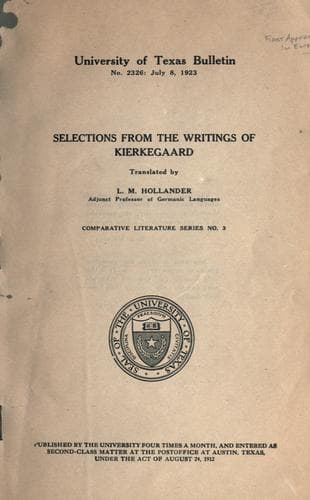
Selections from the Writings of KierkegaardKierkegaard, Søren
Religion
Selections from the Writings of Kierkegaard
Kierkegaard, Søren
Philosophy; Theology
rage against him, against his incredible arrogance and so forth.
This ought not to count with him, whether for or against. In
all truly serious business the law of: either--or, prevails.
Either, I am the man whose serious business this is, I am called
to it, and am willing to take a decisive risk; or, if this be
not the case, then the seriousness of the business demands that
I do not meddle with it at all. Nothing is more detestable and
mean, and nothing discloses and effects a deeper demoralization,
than this lackadaisical wishing to enter "somewhat" into matters
which demand an _aut--aut, aut Cæsar aut nihil_,[8] this taking
just a little part in something, to be so wretchedly lukewarm,
to twaddle about the business, and then by twaddling to usurp
through a lie the attitude of being better than they who wish
not to have anything whatever to do with the whole business--to
usurp through a lie the attitude of being better, and thus to
render doubly difficult the task of him whose business it really
is.
CONFIRMATION AND WEDDING CEREMONY; CHRISTIAN--COMEDY--OR WORSE STILL
(No. VII, 6)
Pricks of conscience (insofar as they may be assumed in this
connection)--pricks of conscience seem to have convinced "Christendom"
that it was, after all, going too far, and that it would not do--this
beastly farce of becoming a Christian by the simple method of
letting a royal official give the infant a sprinkle of water over
his head, which is the occasion for a family gathering with a
banquet to celebrate the day.
This won't do, was the opinion of "Christendom," for the opportunity
ought to be given the baptized individual to indorse personally his
baptismal vows.
For this purpose the rite of confirmation was devised--a splendid
invention, providing we take two things for granted: in the first
place, that the idea of divine worship is to make God ridiculous;
and in the second place, that its purpose is to give occasion
for family celebrations, parties, a jolly evening, a banquet which
is different from other banquets in that it--ah, exquisite--in
that it, "at the same time" has a religious significance.
"The tender child," thus Christendom, "can of course not assume
the baptismal vow personally, for this requires a real personality."
Consequently there was chosen--is this a stroke of genius or
just ingenious?--there was chosen the age of 14 or 15 year's,
the schoolboy age. This real personality--that is all right,
if you please--he is equal to the task of personally assuming
responsibility for the baptismal vow taken in behalf of the infant.
Public-domain text, read in full here on John Shaqi.
Reviews
Reviews
No reviews yet
Be the first to share your thoughts on this work.
Elsewhere in the archive
Join the Discussion
Join the discussion
Sign in to leave a comment or review.
Sign InorCreate an account