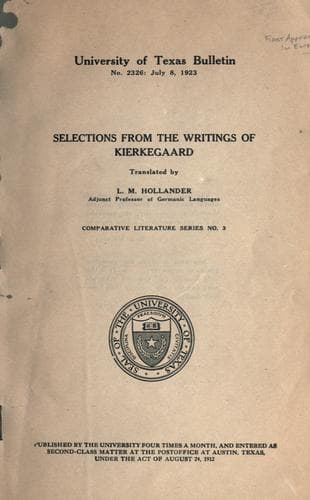
Selections from the Writings of KierkegaardKierkegaard, Søren
Religion
Selections from the Writings of Kierkegaard
Kierkegaard, Søren
Philosophy; Theology
As it happened, the comic paper _Korsaren_ "The Corsair" was then
at the heyday of its career. The first really democratic periodical
in Denmark, it stood above party lines and through its malicious,
brilliant satire and amusing caricatures of prominent personalities
was hated, feared, and enjoyed by everybody. Its editor, the Jewish
author Meir Goldschmidt, was a warm and outspoken admirer of the
philosopher. Kierkegaard, on the other hand, had long regarded
the Press with suspicion. He loathed it because it gave expression
to, and thus subtly flattered, the multitude, "the public,"
"the mob"--as against the individual, and because it worked with
the terrible weapon of anonymity; but held it especially dangerous by
reason of its enormous circulation and daily repetition of mischievous
falsehoods. So it seemed to him who ever doubted the ability of the
"people" to think for themselves. In a word, the Press is to him "the
evil principle in the modern world." Needless to say, the tactics of
"The Corsair," in particular, infuriated him.
In a Christmas annual (1845) there had appeared a blundering
review, by one of the collaborators on "The Corsair," of his "Stages on
Life's Road." Seizing the opportunity offered, Kierkegaard wrote a
caustic rejoinder, adding the challenge: "Would that I now soon appear
in 'The Corsair.' It is really hard on a poor author to be singled out
in Danish literature by remaining the only one who is not abused in
it." We know now that Goldschmidt did his best in a private interview
to ward off a feud, but when rebuffed he turned the batteries of his
ridicule on the personality of his erstwhile idol. And for the better
part of a year the Copenhagen public was kept laughing and grinning
about the unequal trouser legs, the spindle shanks, the inseparable
umbrella, the dialectic propensities, of "Either-Or," as Kierkegaard came
to be called by the populace; for, owing to his peripatetic
habits--acquired in connection with the Indirect Communication--he
had long been a familiar figure on the streets of the capital. While
trying to maintain an air of indifference, he suffered the tortures
of the damned. In his Journal (several hundred of whose pages are
given over to reflections on this experience) we find exclamations
such as this one: "What is it to be roasted alive at a slow fire,
or to be broken on the wheel or, as they do in warm climates, to
be smeared with honey and put at the mercy of the insects--what
is that in comparison with this torture: to be grinned to death!"
Public-domain text, read in full here on John Shaqi.
Reviews
Reviews
No reviews yet
Be the first to share your thoughts on this work.
Join the Discussion
Join the discussion
Sign in to leave a comment or review.
Sign InorCreate an account