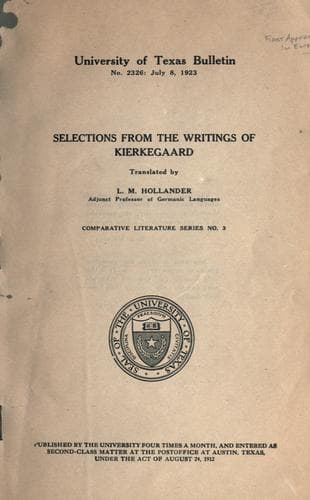
Selections from the Writings of KierkegaardKierkegaard, Søren
Religion
Selections from the Writings of Kierkegaard
Kierkegaard, Søren
Philosophy; Theology
Kierkegaard's physical heredity must be pronounced unfortunate.
Being the child of old parents--his father was fifty-seven,
his mother forty-five years at his birth (May 5, 1813), he had a weak
physique and a feeble constitution. Still worse, he inherited from his
father a burden of melancholy which he took a sad pride in masking
under a show of sprightliness. His father, Michael Pedersen Kierkegaard,
had begun life as a poor cotter's boy in West Jutland, where he was
set to tend the sheep on the wild moorlands. One day, we are told,
oppressed by loneliness and cold, he ascended a hill and in a passionate
rage cursed God who had given him this miserable existence--the
memory of which "sin against the Holy Ghost" he was not able to
shake off to the end of his long life[2]. When seventeen years
old, the gifted lad was sent to his uncle in Copenhagen, who
was a well-to-do dealer in woolens and groceries. Kierkegaard
quickly established himself in the trade and amassed a considerable
fortune. This enabled him to withdraw from active life when only
forty, and to devote himself to philosophic studies, the leisure
for which life had till then denied him. More especially he seems
to have studied the works of the rationalistic philosopher Wolff.
After the early death of his first wife who left him no issue, he
married a former servant in his household, also of Jutish stock,
who bore him seven children. Of these only two survived him, the
oldest son--later bishop--Peder Christian, and the youngest son,
Sören Åbye.
Nowhere does Kierkegaard speak of his mother, a woman of simple
mind and cheerful disposition; but he speaks all the more often of his
father, for whom he ever expressed the greatest love and admiration and
who, no doubt, devoted himself largely to the education of his sons,
particularly to that of his latest born. Him he was to mould in his own
image. A pietistic, gloomy spirit of religiosity pervaded the household
in which the severe father was undisputed master, and absolute obedience
the watchword. Little Sören, as he himself tells us, heard more of the
Crucified and the martyrs than of the Christ-child and good angels. Like
John Stuart Mill, whose early education bears a remarkable resemblance
to his, he "never had the joy to be a child." Although less
systematically held down to his studies, in which religion was the
be-all and end-all (instead of being banished, as was the case with
Mill), he was granted but a minimum of out-door play and exercise. And,
instead of strengthening the feeble body, his father threw the whole
weight of his melancholy on the boy.
Public-domain text, read in full here on John Shaqi.
Reviews
Reviews
No reviews yet
Be the first to share your thoughts on this work.
Join the Discussion
Join the discussion
Sign in to leave a comment or review.
Sign InorCreate an account