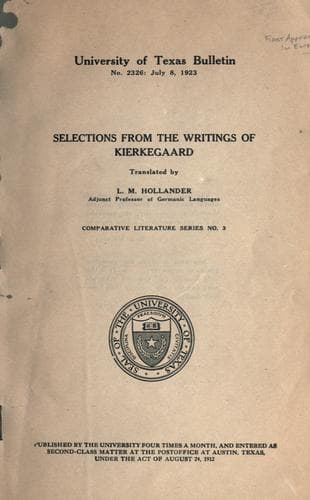
Selections from the Writings of KierkegaardKierkegaard, Søren
Religion
Selections from the Writings of Kierkegaard
Kierkegaard, Søren
Philosophy; Theology
Only once did Constantin abandon his omnipresence in which one
actually lost sight of his presence. At the very beginning he got them
to sing one of the old drinking songs, "by way of calling to mind that
jolly time when men and women feasted together," as he said--a
proposal which had the positively burlesque effect he had perhaps
calculated it should have. It almost gained the upper hand when the
Dressmaker wanted them to sing the ditty: "When I shall mount the
bridal bed, hoiho!" After a couple of courses had been served Constantin
proposed that the banquet should conclude with each one's making a
speech, but that precautions should be taken against the speakers'
divagating too much. He was for making two conditions, viz., there
were to be no speeches until after the meal; and no one was to speak
before having drunk sufficiently to feel the power of the wine--else
he was to be in that condition in which one says much which under
other circumstances one would leave unsaid--without necessarily
having the connection of speech and thought constantly interrupted by
hiccoughs.[7] Before speaking, then, each one was to declare
solemnly that he was in that condition. No definite quantity of wine
was to be required, capacities differed so widely. Against this
proposal, John entered protest. He could never become intoxicated,
he averred, and when he had come to a certain point he grew the
soberer the more he drank. Victor Eremita was of the opinion that
any such preparatory premeditations to insure one's becoming drunk
would precisely militate against one's becoming so. If one desired
to become intoxicated the deliberate wish was only a hindrance. Then
there ensued some discussion about the divers influences of wine on
consciousness, and especially about the fact that, in the case of
a reflective temperament, an excess of wine may manifest itself,
not in any particular _impetus_ but, on the contrary, in a noticeably
cool self-possession. As to the contents of the speeches, Constantin
proposed that they should deal with love, that is, the relation
between man and woman. No love stories were to be told though they
might furnish the text of one's remarks.
The conditions were accepted. All reasonable and just demands a
host may make on his guests were fulfilled: they ate and drank, and
"drank and were filled with drink," as the Bible has it;[8] that is,
they drank stoutly.
The desert was served. Even if Victor had not, as yet, had his desire
gratified to hear the splashing of a fountain--which, for that
matter, he had luckily forgotten since that former conversation--now
champagne flowed profusely. The clock struck twelve. Thereupon
Constantin commanded silence, saluted the Young Person with a goblet
and the words _quod felix sit faustumque_[9] and bade him to speak
first.
(The Young Person's Speech)
Public-domain text, read in full here on John Shaqi.
Reviews
Reviews
No reviews yet
Be the first to share your thoughts on this work.
Join the Discussion
Join the discussion
Sign in to leave a comment or review.
Sign InorCreate an account