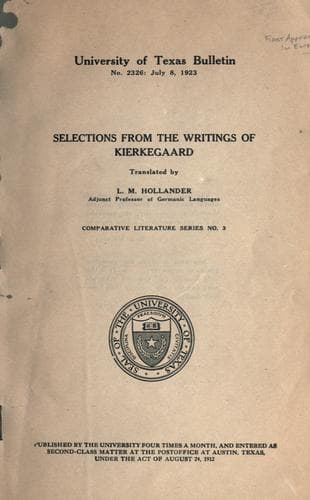
Selections from the Writings of KierkegaardKierkegaard, Søren
Religion
Selections from the Writings of Kierkegaard
Kierkegaard, Søren
Philosophy; Theology
In what, then, consists the lovable? This is my question; but
unfortunately, no one has been able to tell me. The individual lover
always believes that, as far as he is concerned, he knows. Still he
cannot make himself understood by any other lover; and he who listens
to the speech of a number of lovers will learn that no two of them ever
agree, even though they all talk about the same thing. Disregarding
those altogether silly explanations which leave one as wise as before,
that is, end by asserting that it is really the pretty feet of the
beloved damsel, or the admired mustachios of the swain, which are the
objects of love--disregarding these, one will find mentioned, even
in the declamations of lovers in the higher style, first a number of
details and, finally, the declaration: all her lovable ways; and when
they have reached the climax: that inexplicable something I do not know
how to explain. And this speech is meant to please especially beautiful
Lalage. Me it does not please, for I don't understand a word of it and
find, rather, that it contains a double contradiction--first, that
it ends with the inexplicable, second, that it ends with the
inexplicable; for he who intends to end with the inexplicable had best
begin with the inexplicable and then say no more, lest he lay himself
open to suspicion. If he begin with the inexplicable, saying no more,
then this does not prove his helplessness, for it is, anyway, an
explanation in a negative sense; but if he does begin with something
else and lands in the inexplicable, then this does certainly
prove his helplessness.
So then we see: to love corresponds to the lovable; and the lovable
is the inexplicable. Well, that is at least something; but comprehensible
it is not, as little as the inexplicable way in which love seizes
on its prey. Who, indeed, would not be alarmed if people about one,
time and again, dropped down dead, all of a sudden, or had convulsions,
without any one being able to account for it? But precisely in this
fashion does love invade life, only with the difference that one is
not alarmed thereby, since the lovers themselves regard it as their
greatest happiness, but that one, on the contrary, is tempted to
laugh; for the comical and the tragical elements ever correspond to
one another. Today, one may converse with a person and can fairly
well make him out--tomorrow, he speaks in tongues and with strange
gestures: he is in love.
Public-domain text, read in full here on John Shaqi.
Reviews
Reviews
No reviews yet
Be the first to share your thoughts on this work.
Join the Discussion
Join the discussion
Sign in to leave a comment or review.
Sign InorCreate an account