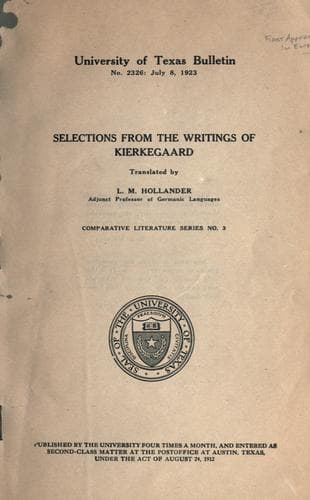
Selections from the Writings of KierkegaardKierkegaard, Søren
Religion
Selections from the Writings of Kierkegaard
Kierkegaard, Søren
Philosophy; Theology
her signifies that he is pursuing an ideal. Perchance he loves
many, but loving many is also a kind of unrequited love; and yet
the ideality of his soul is to be seen in this striving and yearning,
and not in the small bits of lovableness which make up the sum
total of the contributions of all those he loves.
The highest ideality a woman can arouse in a man consists, in fact,
in the awakening within him of the consciousness of immortality.
The point of this proof lies in what one might call the necessity
of a reply. Just as one may remark about some play that it cannot
end without this or that person getting in his say, likewise
(says ideality) our existence cannot be all over with death: I
demand a reply! This proof is frequently furnished, in a positive
fashion, in the public advertiser. I hold that to be entirely proper,
for if proof is to be made in the public advertiser it must be made
in a positive fashion. Thus: Mrs. Petersen, we learn, has lived a
number of years, until in the night of the 24th it pleased Providence,
etc. . This produces in Mr. Petersen an attack of reminiscences from
his courting days or, to express it quite plainly, nothing but seeing
her again will ever console him. For this blissful meeting he
prepares himself, in the meanwhile, by taking unto himself another
wife; for, to be sure, this marriage is by no means as poetic as the
first--still it is a good imitation. This is the proof positive. Mr.
Petersen is not satisfied with demanding a reply, no, he wants a
meeting again in the hereafter.
As is well known, a base metal will often show the gleam of precious
metal. This is the brief silver-gleam. With respect to the base
metal this is a tragic moment, for it must once for all resign itself
to being a base metal. Not so with Mr. Petersen. The possession of
ideality is by rights inherent in every person--and now, if I laugh
at Mr. Petersen it is not because he, being in reality of base metal,
had but a single silver-gleam; but, rather, because just this
silver-gleam betrays his having become a base metal. Thus does the
philistine look most ridiculous when, arrayed in ideality, he affords
fitting occasion to say, with Holberg: "What! does that cow wear a
fine dress, too?[41]"
Public-domain text, read in full here on John Shaqi.
Reviews
Reviews
No reviews yet
Be the first to share your thoughts on this work.
Elsewhere in the archive
Join the Discussion
Join the discussion
Sign in to leave a comment or review.
Sign InorCreate an account