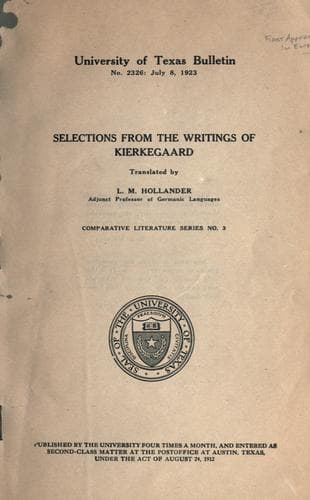
Selections from the Writings of KierkegaardKierkegaard, Søren
Religion
Selections from the Writings of Kierkegaard
Kierkegaard, Søren
Philosophy; Theology
But of what avail to speak here? I do not intend to make proselytes.
Neither is this the place for that. To be sure I love wine, to be
sure I love the abundance of a banquet--all that is good; but let
a girl be my company, and then I shall be eloquent. Let then
Constantin have my thanks for the banquet, and the wine, and the
excellent appointments--the speeches, however, were but indifferent.
But in order that things shall have a better ending I shall
now pronounce a eulogy on woman.
Just as he who is to speak in praise of the divinity must be
inspired by the divinity to speak worthily, and must therefore
be taught by the divinity as to what he shall say, likewise he
who would speak of women. For woman, even less than the divinity,
is a mere figment of man's brain, a day-dream, or a notion that
occurs to one and which one may argue about pro et contra. Nay,
one learns from woman alone what to say of her. And the more
teachers one has had, the better. The first time one is a disciple,
the next time one is already over the chief difficulties, just
as one learns in formal and learned disputations how to use
the last opponent's compliments against a new opponent. Nevertheless
nothing is lost. For as little as a kiss is a mere sample of good
things, and as little as an embrace is an exertion, just as little
is this experience exhaustive. In fact it is essentially different
from the mathematical proof of a theorem, which remains ever the
same, even though other letters be substituted. This method is
one befitting mathematics and ghosts, but not love and women,
because each is a new proof, corroborating the truth of the
theorem in a different manner. It is my joy that, far from being
less perfect than man, the female sex is, on the contrary, the
more perfect. I shall, however, clothe my speech in a myth; and I
shall exult, on woman's account whom you have so unjustly maligned,
if my speech pronounce judgment on your souls, if the enjoyment
of her beckon you only to flee you, as did the fruits from Tantalus;
because you have fled, and thereby insulted, woman. Only thus,
forsooth, may she be insulted, even though she scorn it, and though
punishment instantly falls on him who had the audacity. I, however,
insult no one. That is but the notion of married men, and a slander;
whereas, in reality, I respect her more highly than does the man
she is married to.
Public-domain text, read in full here on John Shaqi.
Reviews
Reviews
No reviews yet
Be the first to share your thoughts on this work.
Elsewhere in the archive
Join the Discussion
Join the discussion
Sign in to leave a comment or review.
Sign InorCreate an account