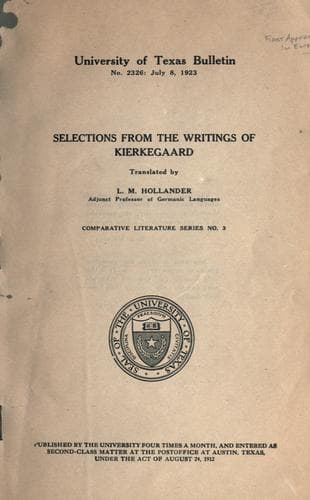
Selections from the Writings of KierkegaardKierkegaard, Søren
Religion
Selections from the Writings of Kierkegaard
Kierkegaard, Søren
Philosophy; Theology
She is finiteness, and as such she is a collective: one woman
represents all women. Only the erotic nature comprehends this and
therefore knows how to love many without ever being deceived, sipping
the while all the delights the cunning gods were able to prepare.
For this reason, as I said, woman cannot be fully expressed by one
formula, but is, rather, an infinitude of finalities. He who wishes
to think her "idea" will have the same experience as he who gazes
on a sea of nebulous shapes which ever form anew, or as he who is
dazed by looking over the waves whose foamy crests ever mock one's
vision; for her "idea" is but the workshop of possibilities. And to
the erotic nature these possibilities are the everlasting reason
for his worship.
So the gods created her delicate and ethereal as if out of
the mists of the summer night, yet goodly like ripe fruit;
light like a bird, though the repository of what attracts all
the world--light because the play of the forces is harmoniously
balanced in the invisible center of a negative relation;[54]
slender in growth, with definite lines, yet her body sinuous
with beautiful curves; perfect, yet ever appearing as if completed
but now; cool, delicious, and refreshing like new-fallen snow,
yet blushing in coy transparency; happy like some pleasantry
which makes one forget all one's sorrow; soothing as being the
end of desire, and satisfying in herself being the stimulus of
desire. And the gods had calculated that man, when first beholding
her, would be amazed, as one who sees himself, though familiar with
that sight--would stand in amaze as one who sees himself in the
splendor of perfection--would stand in amaze as one who beholds
what he did never dream he would, yet beholds what, it would seem,
ought to have occurred to him before--sees what is essential to
life and yet gazes on it as being the very mystery of existence.
It is precisely tins contradiction in his admiration which nurses
desire to life, while this same admiration urges him ever nearer,
so that he cannot desist from gazing, cannot desist from believing
himself familiar with the sight, without really daring to approach,
even though he cannot desist from desiring.
Public-domain text, read in full here on John Shaqi.
Reviews
Reviews
No reviews yet
Be the first to share your thoughts on this work.
Elsewhere in the archive
Join the Discussion
Join the discussion
Sign in to leave a comment or review.
Sign InorCreate an account