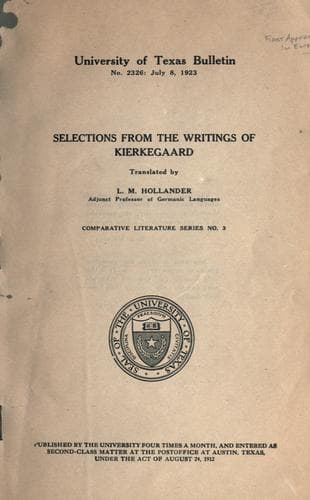
Selections from the Writings of KierkegaardKierkegaard, Søren
Religion
Selections from the Writings of Kierkegaard
Kierkegaard, Søren
Philosophy; Theology
Constantin's flinging his beaker against the door was intended
merely as a symbolic rite; nevertheless, his so doing was, in
a way, a decisive act; for when the last glass was shattered the
door opened, and just as he who presumptuously knocked at Death's
door and, on its opening, beheld the powers of annihilation, so
the banqueters beheld the corps of destruction ready to demolish
everything--a memento which in an instant put them to flight
from that place, while at the very same moment the entire surroundings
had been reduced to the semblance of ruin.
A carriage stood ready at the door. At Constantin's invitation
they seated themselves in it and drove away in good spirits;
for that tableau of destruction which they left behind had given
their souls fresh elasticity. After having covered a distance of
several miles a halt was made. Here Constantin took his leave as
host, informing them that five carriages were at their disposal--each
one was free to suit his own pleasure and drive wherever he wanted,
whether alone or in company with whomsoever he pleased. Thus a
rocket, propelled by the force of the powder, ascends at a single
shot, remains collected for an instant, in order then to spread out
to all the winds.
While the horses were being hitched to the carriages the nocturnal
banqueters strolled a little way down the road. The fresh air of
the morning purified their hot blood with its coolness, and they
gave themselves up to it entirely. Their forms, and the groups in
which they ranged themselves, made a fantastic impression on me.
For when the morning sun shines on field and meadow, and on every
creature which in the night found rest and strength to rise up
jubilating with the sun--in this there is only a pleasing, mutual
understanding; but a nightly company, viewed by the morning light
and in smiling surroundings, makes a downright uncanny impression.
It makes one think of spooks which have been surprised by daylight,
of subterranean spirits which are unable to regain the crevice
through which they may vanish, because it is visible only in the
dark; of unhappy creatures in whom the difference between day and
night has become obliterated through the monotony of their sufferings.
Public-domain text, read in full here on John Shaqi.
Reviews
Reviews
No reviews yet
Be the first to share your thoughts on this work.
Elsewhere in the archive
Join the Discussion
Join the discussion
Sign in to leave a comment or review.
Sign InorCreate an account