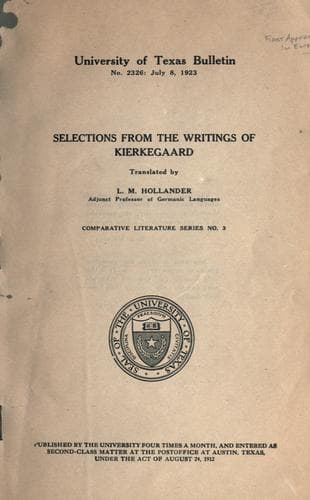
Selections from the Writings of KierkegaardKierkegaard, Søren
Religion
Selections from the Writings of Kierkegaard
Kierkegaard, Søren
Philosophy; Theology
Then they returned home again, and Sarah hastened to meet them;
but Isaac had lost his faith. No one in all the world ever said
a word about this, nor did Isaac speak to any man concerning
what he had seen, and Abraham suspected not that any one had seen it.
When the child is to be weaned, his mother has the stronger food
ready lest the child perish. Happy he who has in readiness this
stronger food!
Thus, and in many similar ways, thought the man whom I have mentioned
about this event. And every time he returned, after a pilgrimage to
Mount Moriah, he sank down in weariness, folding his hands and saying:
"No one, in truth, was great as was Abraham, and who can understand
him?"
A PANEGYRIC ON ABRAHAM
If a consciousness of the eternal were not implanted in man; if
the basis of all that exists were but a confusedly fermenting
element which, convulsed by obscure passions, produced all, both
the great and the insignificant; if under everything there lay
a bottomless void never to be filled--what else were life but
despair? If it were thus, and if there were no sacred bonds
between man and man; if one generation arose after another, as
in the forest the leaves of one season succeed the leaves of
another, or like the songs of birds which are taken up one after
another; if the generations of man passed through the world like
a ship passing through the sea and the wind over the desert--a
fruitless and a vain thing; if eternal oblivion were ever greedily
watching for its prey and there existed no power strong enough to
wrest it from its clutches--how empty were life then, and how
dismal! And therefore it is not thus; but, just as God created
man and woman, he likewise called into being the hero and the
poet or orator. The latter cannot perform the deeds of the hero--he
can only admire and love him and rejoice in him. And yet he
also is happy and not less so; for the hero is, as it were, his
better self with which he has fallen in love, and he is glad he
is not himself the hero, so that his love can express itself in
admiration.
Public-domain text, read in full here on John Shaqi.
Reviews
Reviews
No reviews yet
Be the first to share your thoughts on this work.
Elsewhere in the archive
Join the Discussion
Join the discussion
Sign in to leave a comment or review.
Sign InorCreate an account