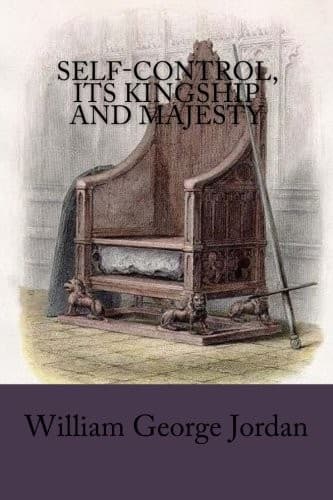
Self-Control, Its Kingship and MajestyJordan, William George
Philosophy
Self-Control, Its Kingship and Majesty
Jordan, William George
Conduct of life; Self-control
True charity is not typified by an almsbox. The benevolence of a check
book does not meet all the wants of humanity. Giving food, clothing and
money to the poor is only the beginning, the kindergarten class, of real
charity. Charity has higher, purer forms of manifestation. Charity is
but an instinctive reaching out for justice in life. Charity seeks to
smooth down the rough places of living, to bridge the chasms of human
sin and folly, to feed the heart-hungry, to give strength to the
struggling, to be tender with human weakness, and greatest of all, it
means—obeying the Divine injunction: “Judge not.”
The true symbol of the greatest charity is the scales of judgment held
on high, suspended from the hand of Justice. So perfectly are they
poised that they are never at rest; they dare not stop for a moment to
pronounce final judgment; each second adds its grain of evidence to
either side of the balance. With this ideal before him, man, conscious
of his own weakness and frailty, dare not arrogate to himself the Divine
prerogative of pronouncing severe or final judgment on any individual.
He will seek to train mind and heart to greater keenness, purity, and
delicacy in watching the trembling movement of the balance in which he
weighs the characters and reputations of those around him.
It is a great pity in life that all the greatest words are most
degraded. We hear people say: “I do so love to study character, in the
cars and on the street.” They are not studying character; they are
merely observing characteristics. The study of character is not a puzzle
that a man may work out over night. Character is most subtle, elusive,
changing and contradictory—a strange mingling of habits, hopes,
tendencies, ideals, motives, weaknesses, traditions and
memories—manifest in a thousand different phases.
There is but one quality necessary for the perfect understanding of
character, one quality that, if man have it, he may _dare to
judge_—that is, omniscience. Most people study character as a
proofreader pores over a great poem: his ears are dulled to the majesty
and music of the lines, his eyes are darkened to the magic imagination
of the genius of the author; that proofreader is busy watching for an
inverted comma, a mis-spacing, or a wrong-font letter. He has an eye
trained for the imperfections, the weaknesses. Men who pride themselves
on being shrewd in discovering the weak points, the vanity, dishonesty,
immorality, intrigue and pettiness of others, think they understand
character. They know only part of character—they know only the depths
to which some men may sink; they know not the heights to which some men
may rise. An optimist is a man who has succeeded in associating with
humanity for some time without becoming a cynic.
Public-domain text, read in full here on John Shaqi.
Reviews
Reviews
No reviews yet
Be the first to share your thoughts on this work.
Join the Discussion
Join the discussion
Sign in to leave a comment or review.
Sign InorCreate an account