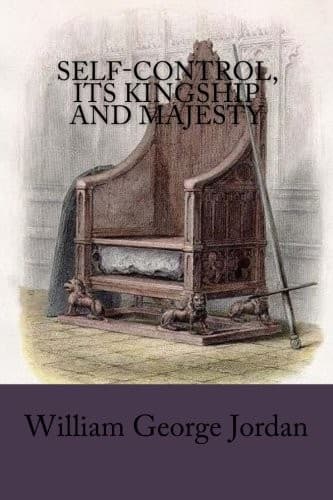
Self-Control, Its Kingship and MajestyJordan, William George
Philosophy
Self-Control, Its Kingship and Majesty
Jordan, William George
Conduct of life; Self-control
If man do, day by day, ever the best he can by the light he has, he has
no need to fear, no need to regret, no need to worry. No agony of worry
would do aught to help him. Neither mortal nor angel can do more than
his best.
If we look back upon our past life we will see how, in the marvellous
working of events, the cities of our greatest happiness and of our
fullest success have been built along the rivers of our deepest sorrows,
our most abject failures. We then realize that our present happiness or
success would have been impossible had it not been for some terrible
affliction or loss in the past,—some wondrous potent force in the
evolution of our character or our fortune. This should be a wondrous
stimulus to us in bearing the trials and sorrows of life.
To cure one’s self of worry is not an easy task; it is not to be removed
in two or three applications of the quack medicine of any cheap
philosophy, but it requires only clear, simple commonsense applied to
the business of life. Man has no right to waste his own energies, to
weaken his own powers and influence, for he has inalienable duties to
himself, to his family, to society, and to the world.
VI
The Greatness _of_ Simplicity
Simplicity is the elimination of the non-essential in all things. It
reduces life to its minimum of real needs; raises it to its maximum of
powers. Simplicity means the survival,—not of the fittest, but of the
best. In morals it kills the weeds of vice and weakness so that the
flowers of virtue and strength may have room to grow. Simplicity cuts
off waste and intensifies concentration. It converts flickering torches
into searchlights.
All great truths are simple. The essence of Christianity could be given
in a few words; a lifetime would be but continued seeking to make those
words real and living in thoughts and acts. The true Christian’s
individual belief is always simpler than his church creed, and upon
these vital, foundation elements he builds his life. Higher criticism
never rises to the heights of his simplicity. He does not care whether
the whale swallowed Jonah or Jonah swallowed the whale. Hair-splitting
interpretation of words and phrases is an intellectual dissipation he
has no time for. He cares naught for the anatomy of religion; he has its
soul. His simple faith he lives,—in thought and word and act, day by
day. Like the lark he lives nearest the ground; like the lark he soars
highest toward heaven.
Public-domain text, read in full here on John Shaqi.
Reviews
Reviews
No reviews yet
Be the first to share your thoughts on this work.
Join the Discussion
Join the discussion
Sign in to leave a comment or review.
Sign InorCreate an account