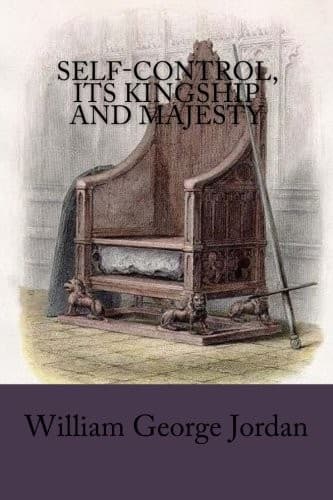
Self-Control, Its Kingship and MajestyJordan, William George
Philosophy
Self-Control, Its Kingship and Majesty
Jordan, William George
Conduct of life; Self-control
The man who is not self-reliant is weak, hesitating and doubting in all
he does. He fears to take a decisive step, because he dreads failure,
because he is waiting for someone to advise him or because he dare not
act in accordance with his own best judgment. In his cowardice and his
conceit he sees all his non-success due to others. He is “not
appreciated,” “not recognized,” he is “kept down.” He feels that in some
subtle way “society is conspiring against him.” He grows almost vain as
he thinks that no one has had such poverty, such sorrow, such
affliction, such failure as have come to him.
The man who is self-reliant seeks ever to discover and conquer the
weakness within him that keeps him from the attainment of what he holds
dearest; he seeks within himself the power to battle against all outside
influences. He realizes that all the greatest men in history, in every
phase of human effort, have been those who have had to fight against the
odds of sickness, suffering, sorrow. To him, defeat is no more than
passing through a tunnel is to a traveller,—he knows he must emerge
again into the sunlight.
The nation that is strongest is the one that is most self-reliant, the
one that contains within its boundaries all that its people need. If,
with its ports all blockaded it has not within itself the necessities of
life and the elements of its continual progress then,—it is weak, held
by the enemy, and it is but a question of time till it must surrender.
Its independence is in proportion to its self-reliance, to its power to
sustain itself from within. What is true of nations is true of
individuals. The history of nations is but the biography of individuals
magnified, intensified, multiplied, and projected on the screen of the
past. History is the biography of a nation; biography is the history of
an individual. So it must be that the individual who is most strong in
any trial, sorrow or need is he who can live from his inherent strength,
who needs no scaffolding of commonplace sympathy to uphold him. He must
ever be self-reliant.
The wealth and prosperity of ancient Rome, relying on her slaves to do
the real work of the nation, proved the nation’s downfall. The constant
dependence on the captives of war to do the thousand details of life for
them, killed self-reliance in the nation and in the individual. Then,
through weakened self-reliance and the increased opportunity for idle,
luxurious ease that came with it, Rome, a nation of fighters, became,—a
nation of men more effeminate than women. As we depend on others to do
those things we should do ourselves, our self-reliance weakens and our
powers and our control of them becomes continuously less.
Public-domain text, read in full here on John Shaqi.
Reviews
Reviews
No reviews yet
Be the first to share your thoughts on this work.
Join the Discussion
Join the discussion
Sign in to leave a comment or review.
Sign InorCreate an account