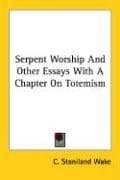
Serpent-Worship, and Other Essays, with a Chapter on TotemismWake, C. Staniland (Charles Staniland)
Religion
Serpent-Worship, and Other Essays, with a Chapter on Totemism
Wake, C. Staniland (Charles Staniland)
Phallicism; Serpent worship; Totemism
How far the condition of women has been mitigated among the Bedouins
and other races by Mohammedanism is an open question. According to the
Koran, the Arabs were accustomed to treat them with great cruelty,
while one of the chief features of Mohammed’s teaching is the high
position accorded to them. In permitting polygamy, Mohammedan law
accommodates itself to the habits of an earlier stage of social
progress, and tends to perpetuate many of its objectionable features.
As remarked by Lord Kames, polygamy is intimately connected with the
treatment of woman as a slave to be purchased even in marriage. But,
great as are the evils attending that custom, they depend in great
measure on special circumstances, and they are capable, as Mohammedan
teaching shows, of considerable mitigation. Probably the practice of
polygamy has never, among a civilised people, been accompanied by more
baneful results than it exhibits in modern Egypt, if we can accept the
testimony of Miss Martineau. This lady somewhat unjustly remarks that,
“if we are to look for a hell upon earth, it is where polygamy exists;
and that, as polygamy runs riot in Egypt, Egypt is the lowest depth of
this hell.” Polygamy has not in India so degrading an effect, but, of
the six qualities ascribed to woman by the code of so-called Gentoo
laws, all are bad ones. A really good wife is, however, so highly
esteemed that, if a man forsake her of his own accord, he is to receive
the punishment of a thief. Perhaps the scarcity of such wives accounts
for the fact mentioned by Bishop Heber, that throughout India anything
is thought good enough for women, and that “the roughest words, the
poorest garments, the scantiest alms, the most degrading labour, and
the hardest blows, are generally of their portion.” No doubt women
of the lower castes are here referred to, and it cannot be supposed
that all women are thus treated. The Abbé Dubois, indeed, affirms
that among the Hindoos the person of a woman is sacred, and that,
however abject her condition, she is always addressed by every one by
the term “mother.” If we may believe the Abbé, who lived for thirty
years among the natives, the position of Hindoo women is far superior
to what Europeans in general believe. He says, “To them belong the
entire management of their household, the care of their children, the
superintendence over the menial servants, the distribution of alms
and charities. To them are generally entrusted the money, jewels, and
other valuables of the family; to them belong the care of procuring
provisions and providing for all expenses; it is they also who are
charged, almost to the exclusion of their husbands, with the most
important affairs of procuring wives for their sons, and husbands for
their daughters, and in doing it they evince a nicety of attention and
wisdom which are not certainly surpassed in any other country; while
in the management of their domestic business, they in general show a
Public-domain text, read in full here on John Shaqi.
Reviews
Reviews
No reviews yet
Be the first to share your thoughts on this work.
Elsewhere in the archive
Join the Discussion
Join the discussion
Sign in to leave a comment or review.
Sign InorCreate an account