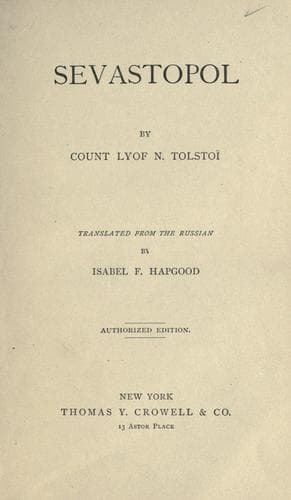
Sevastopol (Ukraine) -- History -- Siege, 1854-1855 -- Fiction
Thus you have seen the defenders of Sevastopol, on the very scene of
the defence, and you go back paying no attention, for some reason
or other, to the cannon-balls and bullets, which continue to shriek
the whole way until you reach the ruined theatre,—you proceed with
composure, and with your soul in a state of exaltation.
The principal and cheering conviction which you have brought away is
the conviction of the impossibility of the Russian people wavering
anywhere whatever—and this impossibility you have discerned not in the
multitude of traverses, breastworks, artfully interlaced trenches,
mines, and ordnance, piled one upon the other, of which you have
comprehended nothing; but you have discerned it in the eyes, the
speech, the manners, in what is called the spirit of the defenders
of Sevastopol. What they are doing they do so simply, with so little
effort and exertion, that you are convinced that they can do a hundred
times more—that they can do anything. You understand that the feeling
which makes them work is not a feeling of pettiness, ambition,
forgetfulness, which you have yourself experienced, but a different
sentiment, one more powerful, and one which has made of them men who
live with their ordinary composure under the fire of cannon, amid
hundreds of chances of death, instead of the one to which all men are
subject who live under these conditions amid incessant labor, poverty,
and dirt. Men will not accept these frightful conditions for the sake
of a cross or a title, nor because of threats; there must be another
lofty incentive as a cause, and this cause is the feeling which rarely
appears, of which a Russian is ashamed, that which lies at the bottom
of each man's soul—love for his country.
Only now have the tales of the early days of the siege of Sevastopol,
when there were no fortifications there, no army, no physical
possibility of holding it, and when at the same time there was not
the slightest doubt that it would not surrender to the enemy,—of the
days when that hero worthy of ancient Greece, Korniloff, said, as he
reviewed the army: “We will die, children, but we will not surrender
Sevastopol;” and our Russians, who are not fitted to be phrase-makers,
replied: “We will die! hurrah!”—only now have tales of that time ceased
to be for you the most beautiful historical legends, and have become
real facts and worthy of belief. You comprehend clearly, you figure
to yourself, those men whom you have just seen, as the very heroes of
those grievous times, who have not fallen, but have been raised by the
spirit, and have joyfully prepared for death, not for the sake of the
city, but of the country. This epos of Sevastopol, whose hero was the
Russian people, will leave mighty traces in Russia for a long time to
come.
Public-domain text, read in full here on John Shaqi.
Reviews
Reviews
No reviews yet
Be the first to share your thoughts on this work.
Join the Discussion
Join the discussion
Sign in to leave a comment or review.
Sign InorCreate an account