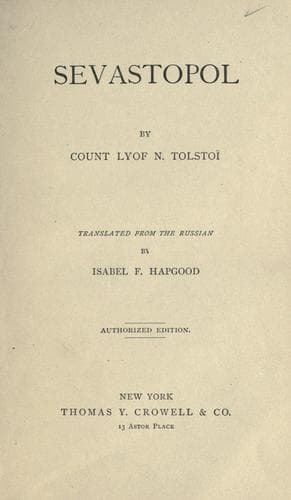
Sevastopol (Ukraine) -- History -- Siege, 1854-1855 -- Fiction
Let us rather observe this lad of ten, clad in an ancient cap, his
father's probably, shoes worn on bare feet, and nankeen breeches, held
up by a single suspender, who had climbed over the wall at the very
beginning of the truce, and has been roaming about the ravine, staring
with dull curiosity at the French, and at the bodies which are lying
on the earth, and plucking the blue wild-flowers with which the valley
is studded. On his way home with a large bouquet, he held his nose
because of the odor which the wind wafted to him, and paused beside
a pile of corpses, which had been carried off the field, and stared
long at one terrible headless body, which chanced to be the nearest to
him. After standing there for a long while, he stepped up closer, and
touched with his foot the stiffened arm of the corpse which protruded.
The arm swayed a little. He touched it again, and with more vigor.
The arm swung back, and then fell into place again. And at once the
boy uttered a shriek, hid his face in the flowers, and ran off to the
fortifications as fast as he could go.
Yes, white flags are hung out from the bastion and the trenches, the
flowery vale is filled with dead bodies, the splendid sun sinks into
the blue sea, and the blue sea undulates and glitters in the golden
rays of the sun. Thousands of people congregate, gaze, talk, and smile
at each other. And why do not Christian people, who profess the one
great law of love and self-sacrifice, when they behold what they have
wrought, fall in repentance upon their knees before Him who, when he
gave them life, implanted in the soul of each of them, together with a
fear of death, a love of the good and the beautiful, and, with tears
of joy and happiness, embrace each other like brothers? No! But it
is a comfort to think that it was not we who began this war, that we
are only defending our own country, our father-land. The white flags
have been hauled in, and again the weapons of death and suffering are
shrieking; again innocent blood is shed, and groans and curses are
audible.
* * * * *
I have now said all that I wish to say at this time. But a heavy
thought overmasters me. Perhaps it should not have been said;
perhaps what I have said belongs to one of those evil truths which,
unconsciously concealed in the soul of each man, should not be uttered,
lest they become pernicious, as a cask of wine should not be shaken,
lest it be thereby spoiled.
Where is the expression of evil which should be avoided? Where is the
expression of good which should be imitated in this sketch? Who is the
villain, who the hero? All are good, and all are evil.
Public-domain text, read in full here on John Shaqi.
Reviews
Reviews
No reviews yet
Be the first to share your thoughts on this work.
Join the Discussion
Join the discussion
Sign in to leave a comment or review.
Sign InorCreate an account