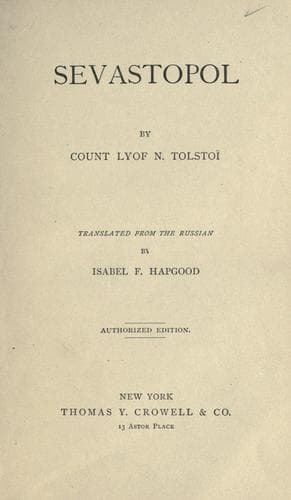
Sevastopol (Ukraine) -- History -- Siege, 1854-1855 -- Fiction
A thick-lipped young doctor and an officer of artillery, with a German
cast of countenance, were seated almost on the feet of the young
officer who was sleeping on the sofa, and counting over their money.
There were four officers' servants, some dozing and others busy with
the trunks and packages near the door.
Among all these faces, Kozeltzoff did not find a single familiar
one; but he began to listen with curiosity to the conversation. The
young officers, who, as he decided from their looks alone, had but
just come out of the military academy, pleased him, and, what was the
principal point, they reminded him that his brother had also come from
the academy, and should have joined recently one of the batteries of
Sevastopol.
But the officer with the satchel, whose face he had seen before
somewhere, seemed bold and repulsive to him. He even left the window,
and, going to the stove-bench, seated himself on it, with the thought
that he would put the fellow down if he took it into his head to say
anything. In general, purely as a brave “line” officer, he did not like
“the staff,” such as he had recognized these two officers to be at the
first glance.
IV.
“But this is dreadfully annoying,” said one of the young officers, “to
be so near, and yet not be able to get there. Perhaps there will be an
action this very day, and we shall not be there.”
In the sharp voice and the mottled freshness of the color that swept
across the youthful face of this officer as he spoke there was apparent
the sweet young timidity of the man who is constantly afraid lest his
every word shall not turn out exactly right.
The one-armed officer glanced at him with a smile.
“You will get there soon enough, I assure you,” he said.
The young officer looked with respect at the haggard face of the
armless officer, so unexpectedly illuminated by a smile, held his peace
for a while, and busied himself once more with his tea. In fact, the
one-armed officer's face, his attitude, and, most of all, the empty
sleeve of his coat, expressed much of that tranquil indifference that
may be explained in this way—that he looked upon every conversation and
every occurrence as though saying, “That is all very fine; I know all
about that, and I can do a little of that myself, if I only choose.”
“What is our decision to be?” said the young officer again to his
companion in the short coat. “Shall we pass the night here, or shall we
proceed with our own horses?”
His comrade declined to proceed.
“Just imagine, captain,” said the one who was pouring the tea, turning
to the one-armed man, and picking up the knife that the latter had
dropped, “they told us that horses were frightfully dear in Sevastopol,
so we bought a horse in partnership at Simferopol.”
“They made you pay pretty high for it, I fancy.”
“Really, I do not know, captain; we paid ninety rubles for it and the
team. Is that very dear?” he added, turning to all the company, and to
Kozeltzoff, who was staring at him.
Public-domain text, read in full here on John Shaqi.
Reviews
Reviews
No reviews yet
Be the first to share your thoughts on this work.
Join the Discussion
Join the discussion
Sign in to leave a comment or review.
Sign InorCreate an account