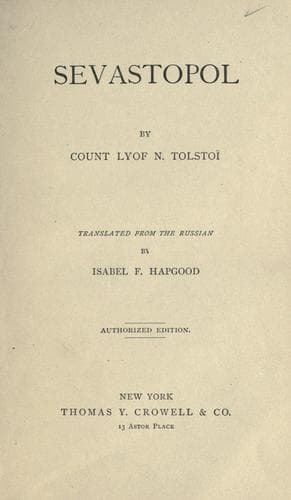
Sevastopol (Ukraine) -- History -- Siege, 1854-1855 -- Fiction
Volodya, without a shudder, gazed upon this terrible place of which
he had thought so much; on the contrary, he did so with an æsthetic
enjoyment, and a heroic sense of self-satisfaction at the idea that
here he was—he would be there in another half-hour, that he would
behold that really charmingly original spectacle—and he stared with
concentrated attention from that moment until they arrived at the north
fortification, at the baggage-train of his brother's regiment, where
they were to ascertain with certainty the situations of the regiment
and the battery.
The officer in charge of the train lived near the so-called new town
(huts built of boards by the sailors' families), in a tent, connecting
with a tolerably large shed, constructed out of green oak-boughs, that
were not yet entirely withered.
The brothers found the officer seated before a greasy table, upon which
stood a glass of cold tea, a tray with vodka, crumbs of dry sturgeon
roe, and bread, clad only in a shirt of a dirty yellow hue, and engaged
in counting a huge pile of bank-bills on a large abacus.
But before describing the personality of the officer, and his
conversation, it is indispensable that we should inspect with more
attention the interior of his shed, and become a little acquainted, at
least, with his mode of life and his occupations. The new shed, like
those built for generals and regimental commanders, was large, closely
wattled, and comfortably arranged, with little tables and benches, made
of turf. The sides and roof were hung with three rugs, to keep the
leaves from showering down, and, though extremely ugly, they were new,
and certainly costly.
Upon the iron bed, which stood beneath the principal rug, with a young
amazon depicted on it, lay a plush coverlet, of a brilliant crimson,
a torn and dirty pillow, and a raccoon cloak. On the table stood a
mirror, in a silver frame, a silver brush, frightfully dirty, a broken
horn comb, full of greasy hair, a silver candlestick, a bottle of
liqueur, with a huge gold and red label, a gold watch, with a portrait
of Peter I., two gold pens, a small box, containing pills of some sort,
a crust of bread, and some old, castaway cards, and there were bottles,
both full and empty, under the bed.
This officer had charge of the commissariat of the regiment and the
fodder of the horses. With him lived his great friend, the commissioner
who had charge of the operations.
Public-domain text, read in full here on John Shaqi.
Reviews
Reviews
No reviews yet
Be the first to share your thoughts on this work.
Join the Discussion
Join the discussion
Sign in to leave a comment or review.
Sign InorCreate an account