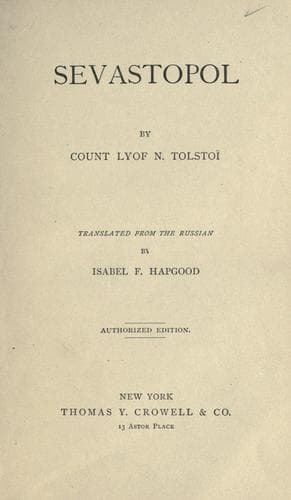
Sevastopol (Ukraine) -- History -- Siege, 1854-1855 -- Fiction
At another corner of the table, over a dish of cutlets with peas, and
a bottle of sour Crimean wine called “Bordeaux,” sit two infantry
officers; one with a red collar, who is young and has two stars on his
coat, is telling the other, with a black collar and no stars, about the
affair at Alma. The former has already drunk a good deal, and it is
evident, from the breaks in his narrative, from his undecided glance
expressive of doubt as to whether he is believed, and chiefly from
the altogether too prominent part which he has played in it all, and
from the excessive horror of it all, that he is strongly disinclined
to bear strict witness to the truth. But these tales, which you will
hear for a long time to come in every corner of Russia, are nothing
to you; you prefer to go to the bastions, especially to the fourth,
of which you have heard so many and such diverse things. When any one
says that he has been in the fourth bastion, he says it with a peculiar
air of pride and satisfaction; when any one says, “I am going to the
fourth bastion,” either a little agitation or a very great indifference
is infallibly perceptible in him; when any one wants to jest about
another, he says, “You must be stationed in the fourth bastion;” when
you meet litters and inquire whence they come, the answer is generally,
“From the fourth bastion.” On the whole, two totally different opinions
exist with regard to this terrible bastion; one is held by those who
have never been in it, and who are convinced that the fourth bastion is
a regular grave for every one who enters it, and the other by those
who live in it, like the white-lashed midshipman, and who, when they
mention the fourth bastion, will tell you whether it is dry or muddy
there, whether it is warm or cold in the mud hut, and so forth.
During the half-hour which you have passed in the inn, the weather has
changed; a fog which before spread over the sea has collected into
damp, heavy, gray clouds, and has veiled the sun; a kind of melancholy,
frozen mist sprinkles from above, and wets the roofs, the sidewalks,
and the soldiers' overcoats.
Public-domain text, read in full here on John Shaqi.
Reviews
Reviews
No reviews yet
Be the first to share your thoughts on this work.
Join the Discussion
Join the discussion
Sign in to leave a comment or review.
Sign InorCreate an account