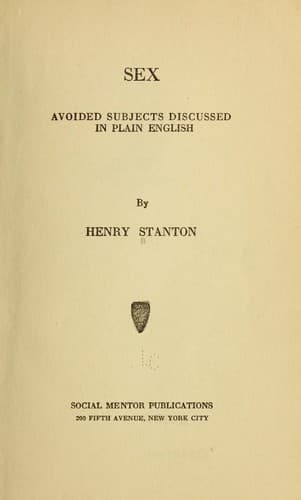
Sex: Avoided subjects Discussed in Plain EnglishStanton, Henry
Science
Sex: Avoided subjects Discussed in Plain English
Stanton, Henry
Sex -- Popular works; Sex instruction
The so-called "Twilight Sleep," a modern development, by which the
pangs of childbirth are obviated by the administration of drugs or by
hypnotic suggestion, has its opponents and defenders. The advantage of
a painless childbirth, upon which the mother can look back as on a
dream, is evident. The "Twilight Sleep" process has been used with the
happiest results both for parent and child. Opponents of this system
declare that the use of powerful drugs may injure the child. A method
commended is the administration of a mixture of laughing gas and
oxygen, which relieves the mother and does not affect the child.
THE NEW-BORN INFANT
The average weight of the new-born child is about seven and a half
pounds. It is insensitive to pain for the first few days, and seems
deaf (since its middle ears are filled with a thick mucus) for the
first two weeks. During the first few days, too, it does not seem able
to see. The first month of its existence is purely automatic.
Evidences of dawning intelligence appear in the second month and at
four months it will recognize mother or nurse. Muscularly it is poorly
developed. Not until two months old is it able to hold up its head,
and not until three months does voluntary muscular movement put in an
appearance. The new-born's first self-conscious act is to draw breath.
Deprived of its usual means of supply it must breathe or suffocate.
Its next is to suck milk, lest it starve.
HEREDITY
We often find children who offer a striking resemblance to a paternal
grandfather, a maternal aunt or a maternal great-grandmother. This is
known as atavism. There are many curious variations with regard to the
inheritance of ancestral traits. Some children show a remarkable
resemblance to their fathers in childhood, others to their mothers.
And many qualities of certain individual ancestors appear quite
suddenly late in life. Everything may be inherited, from the most
delicate shadings of the disposition, the intelligence and the will
power, to the least details of hair, nails and bone structure, etc.
And the combination of the qualities of one's ancestors in heredity is
so manifold and so unequal that it is extremely difficult to arrive at
fixed conclusions regarding it. Hereditary traits and tendencies are
developed out of the energies of the original conjugated germ-cells
throughout life, up to the very day of death. Even aged men often show
peculiarities in the evening of their life which may be clearly
recognized as inherited, and duplicating others shown by their
forbears at the same period of life.
As has already been mentioned every individual inherits, generally
speaking, as much from his paternal as from his maternal progenitors.
This in spite of the fact that the tiny paternal germ-cell is the
only medium of transmission of the paternal qualities, while the
mother furnishes the much larger egg-cell, and feeds him throughout
the embryonic period.
Public-domain text, read in full here on John Shaqi.
Reviews
Reviews
No reviews yet
Be the first to share your thoughts on this work.
Join the Discussion
Join the discussion
Sign in to leave a comment or review.
Sign InorCreate an account