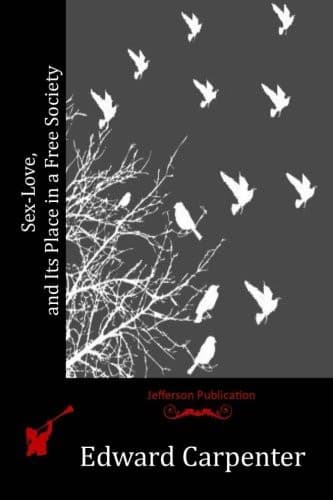
Sex-Love, and Its Place in a Free Society — John Shaqi
Sex-Love, and Its Place in a Free SocietyCarpenter, Edward
Philosophy
Sex-Love, and Its Place in a Free Society
Carpenter, Edward
Sex; Sexual ethics
At the last and taking it as a whole one has the same difficulty in
dealing with the subject of Love which meets one at every turn in
modern life--the monstrous separation of one part of our nature
from another--the way in which--no doubt in the necessary course of
evolution--we have cut ourselves in twain as it were, and assigned
"right" and "wrong," heaven and hell, spiritual and material, and other
violent distinctions, to the separate portions. We have eaten of the
Tree of Knowledge of good and evil with a vengeance! The Lord has indeed
driven us out of Paradise into the domain of that "fabro vulcano" who
with tremendous hammer-strokes must _hammer the knowledge of good and
evil out of us again_. I feel that I owe an apology to the beautiful god
for daring even for a moment to think of dissecting him soul from body,
and for speaking as if these artificial distinctions were in any wise
eternal. Will the man or woman, or race of men and women, never come,
to whom love in its various manifestations shall be from the beginning a
perfect whole, pure and natural, free and standing sanely on its feet?
APPENDIX.
"I analysed a flower, I pointed out to her the beauty of colouring, the
gracefulness of shape, the tender shades, the difference between the
parts composing the flowers. Gradually, I told her what these parts were
called. I showed her the pollen, which clung like a beautiful golden
powder to her little rosy fingers. I showed her through the microscope
that this beautiful powder was composed of an infinite number of small
grains. I made her examine the pistil more closely, and I showed her, at
the end of the tube, the ovary, which I called a 'little house full of
very tiny children.' I showed her the pollen glued to the pistil, and I
told her, that when the pollen of one flower, carried away by the wind,
or by the insects, fell on the pistil of another flower, the small
grains died, and a tiny drop of moisture passed through the tube and
entered into the little house where the very tiny children dwelt; that
these tiny children were like small eggs, that in each small egg there
was an almost invisible opening, through which a little of the small
drop passed; that when this drop of pollen mixed with some other
wonderful power in the ovary, that both joined together to give life,
and the eggs developed and became grains or fruit. I have shown her
flowers which had only a pistil and others which had only stamens. I
said to her, smiling, that the pistils were like little mothers, and the
stamens like little fathers of the fruit....
Public-domain text, read in full here on John Shaqi.
Reviews
Reviews
No reviews yet
Be the first to share your thoughts on this work.
Join the Discussion
Join the discussion
Sign in to leave a comment or review.
Sign InorCreate an account