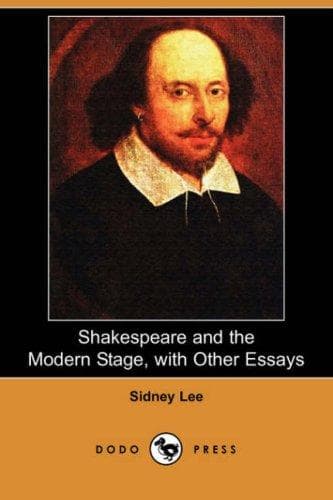
Shakespeare and the Modern Stage; with Other Essays — John Shaqi
Shakespeare and the Modern Stage; with Other EssaysLee, Sidney, Sir
History
Shakespeare and the Modern Stage; with Other Essays
Lee, Sidney, Sir
Shakespeare, William, 1564-1616; Shakespeare, William, 1564-1616 -- Stage history
The practical manager, who naturally seeks pecuniary profit from his
ventures, insists that these suggestions are counsels of perfection
and these anticipations wild and fantastic dreams. His last word is
that by spectacular method Shakespeare can alone be made to "pay" in
the theatre. But are we here on perfectly secure ground? Has the
commercial success attending the spectacular production of Shakespeare
been invariably so conspicuous as to put summarily out of court, on
the purely commercial ground, the method of simplicity? The pecuniary
results are public knowledge in the case of the two most strenuous and
prolonged endeavours to give Shakespeare the splendours of spectacle
which have yet been completed on the London stage. What is the message
of these two efforts in mere pecuniary terms?
Charles Kean may be regarded as the founder of the modern spectacular
system, though it had some precedents, and has been developed since
his day. Charles Kean, between 1851 and 1859, persistently endeavoured
by prodigal and brilliant display to make the production of
Shakespeare an enterprise of profit at the Princess's Theatre, London.
The scheme proved pecuniarily disastrous.
Subsequently Kean's mantle was assumed by the late Sir Henry Irving,
the greatest of recent actors and stage-managers, who in many regards
conferred incalculable benefits on the theatre-going public and on the
theatrical profession. Throughout the last quarter of the last
century, Irving gave the spectacular and scenic system in the
production of Shakespeare every advantage that it could derive from
munificent expenditure and the co-operation of highly endowed artists.
He could justly claim a finer artistic sentiment and a higher
histrionic capacity than Charles Kean possessed. Yet Irving announced,
not long before his death, that he lost on his Shakespearean
productions a hundred thousand pounds. Sir Henry added:
The enormous cost of a Shakespearean production on the
liberal and elaborate scale which the public is now
accustomed to expect makes it almost impossible for any
manager--I don't care who it is--to pursue a continuous
policy of Shakespeare for many years with any hope of profit
in the long run.
In face of this authoritative pronouncement, it must be conceded that
the spectacular system has been given, within recent memory, every
chance of succeeding, and, as far as recorded testimony is available,
has been, from the commercial point of view, a failure.
Public-domain text, read in full here on John Shaqi.
Reviews
Reviews
No reviews yet
Be the first to share your thoughts on this work.
Join the Discussion
Join the discussion
Sign in to leave a comment or review.
Sign InorCreate an account