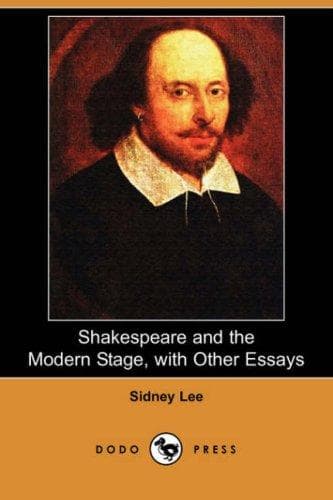
Shakespeare and the Modern Stage; with Other EssaysLee, Sidney, Sir
History
Shakespeare and the Modern Stage; with Other Essays
Lee, Sidney, Sir
Shakespeare, William, 1564-1616; Shakespeare, William, 1564-1616 -- Stage history
To this text Shakespeare constantly recurs, and he bestows on it all
his fertile resources of illustration. The reiterated exposition by
Shakespeare of the hollowness of kingly ceremony is a notable feature
of his political sentiment The dramatist's independent analysis of the
quiddity of kingship is, indeed, alike in manner and matter, a
startling contribution to sixteenth century speculation. In manner it
is worthy of Shakespeare's genius at its highest. In matter it is for
its day revolutionary rationalism. It defies a popular doctrine, held
almost universally by Shakespeare's contemporary fellow-countrymen,
that royalty is divine and under God's special protection, that the
gorgeous ceremony of the throne reflects a heavenly attribute, and
that the king is the pampered favourite of heaven.
Bacon defined a king with slender qualifications, as "a mortal god on
earth unto whom the living God has lent his own name." Shakespeare was
well acquainted with this accepted doctrine. He often gives dramatic
definition of it. He declines to admit its soundness. Wherever he
quotes it, he adds an ironical comment, which was calculated to
perturb the orthodox royalist. Having argued that the day-labourer or
the shepherd is far happier than a king, he logically refuses to admit
that the monarch is protected by God from any of the ills of
mortality. Richard II. may assert that "the hand of God alone, and no
hand of blood or bone" can rob him of the sacred handle of his
sceptre. But the catastrophe of the play demonstrates that that theft
is entirely within human scope. The king is barbarously murdered. In
_Hamlet_ the graceless usurping uncle declares that "such divinity
doth hedge a king," that treason cannot endanger his life. But the
speaker is run through the body very soon after the brag escapes his
lips.
Shakespeare is no comfortable theorist, no respecter of orthodox
doctrine, no smooth-tongued approver of fashionable dogma. His acute
intellect cuts away all the cobwebs, all the illusions, all the
delusions, of formulae. His untutored insight goes down to the root of
things; his king is not Philosopher Bacon's "mortal god on earth"; his
king is "but a man as I am," doomed to drag out a large part of his
existence in the galling chains of "tradition, form and ceremonious
duty," of unreality and self-deception.
Shakespeare's intuitive power of seeing things as they are, affects
his attitude to all social conventions. Not merely royal rulers of men
are in a false position, ethically and logically. "Beware of
appearances," is Shakespeare's repeated warning to men and women of
all ranks in the political or social hierarchy. "Put not your trust in
ornament, be it of gold or of silver." In the spheres of law and
religion, the dramatist warns against pretence, against shows of
virtue, honesty, or courage which have no solid backing.
Public-domain text, read in full here on John Shaqi.
Reviews
Reviews
No reviews yet
Be the first to share your thoughts on this work.
Elsewhere in the archive
Join the Discussion
Join the discussion
Sign in to leave a comment or review.
Sign InorCreate an account