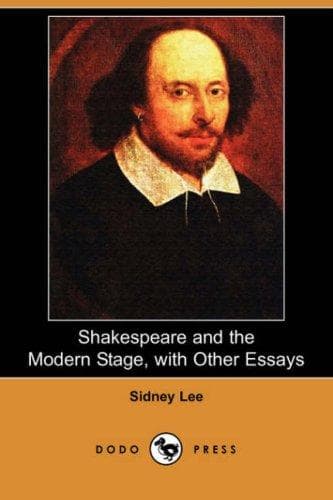
Shakespeare and the Modern Stage; with Other EssaysLee, Sidney, Sir
History
Shakespeare and the Modern Stage; with Other Essays
Lee, Sidney, Sir
Shakespeare, William, 1564-1616; Shakespeare, William, 1564-1616 -- Stage history
The world is still deceiv'd with ornament.
In law what plea so tainted and corrupt
But, being season'd with a gracious voice,
Obscures the show of evil? In religion
What damned error, but some sober brow
Will bless it and approve it with a text,
Hiding the grossness with fair ornament?
There is no vice so simple but assumes
Some mark of virtue on his outward parts:
How many cowards, whose hearts are all as false
As stairs of sand, wear yet upon their chins
The beards of Hercules and frowning Mars,
Who, inward searched, have livers white as milk.
(_Merchant of Venice_, III., ii., 74-86.)
Shakespeare was no cynic. He was not unduly distrustful of his
fellow-men. He was not always suspecting them of something
indistinguishable from fraud. When he wrote, "The world is still
deceived with ornament" which "obscures the show of evil," he was
expressing downright hatred--not suspicion--of sham, of quackery, of
cant. His is the message of all commanding intellects which see
through the hearts of men. Shakespeare's message is Carlyle's message
or Ruskin's message anticipated by nearly three centuries, and more
potently and wisely phrased.
IV
At the same time as Shakespeare insists on the highest and truest
standard of public duty, he, with characteristically practical
insight, acknowledges no less emphatically the necessity or duty of
obedience to duly regulated governments. There may appear
inconsistency in first conveying the impression that governments, or
their officers, are usually unworthy of trust, and then in bidding
mankind obey them implicitly. But, although logical connection between
the two propositions be wanting, they are each convincing in their
place. Both are the outcome of a robust common-sense. Order is
essential to a nation's well-being. There must be discipline in
civilised communities. Officers in authority must be obeyed. These are
the axiomatic bases of every social contract, and no question of the
personal fitness of officers of state impugns their stability.
Twice does Shakespeare define in the same terms what he understands by
the principle of all-compelling order, which is inherent in
government. Twice does he elaborate the argument that precise orderly
division of offices, each enjoying full and unquestioned authority, is
essential to the maintenance of a state's equilibrium.
The topic was first treated in the speeches of Henry V.'s
councillors:--
_Exeter._ For government, though high and low and lower,
Put into parts, doth keep in one consent,
Congreeing in a full and natural close,
Like music.
Public-domain text, read in full here on John Shaqi.
Reviews
Reviews
No reviews yet
Be the first to share your thoughts on this work.
Elsewhere in the archive
Join the Discussion
Join the discussion
Sign in to leave a comment or review.
Sign InorCreate an account