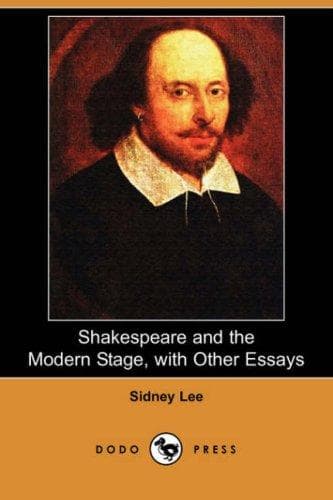
Shakespeare and the Modern Stage; with Other EssaysLee, Sidney, Sir
History
Shakespeare and the Modern Stage; with Other Essays
Lee, Sidney, Sir
Shakespeare, William, 1564-1616; Shakespeare, William, 1564-1616 -- Stage history
Shakespeare argues, in effect, that a man reaps as he sows. It may be
contended that Nature does not always work in strict accord with this
Shakespearean canon, and that Shakespeare thereby shows himself more
of a deliberate moralist than Nature herself. But the dramatist
idealises or generalises human experience; he does not reproduce it
literally. There is nothing in the Shakespearean canon that runs
directly counter to the idealised or generalised experience of the
outer world. The wicked and the foolish, the intemperate and the
over-passionate, reach in Shakespeare's world that disastrous goal,
which nature at large keeps in reserve for them and only by rare
accident suffers them to evade. The father who brings up his children
badly and yet expects every dutiful consideration from them is only in
rare conditions spared the rude awakening which overwhelms King Lear.
The jealous husband who wrongly suspects his wife of infidelity
commonly suffers the fate either of Othello or of Leontes.
VI
Shakespeare regards it as the noblest ambition in man to master his
own destiny. There are numerous passages in which the dramatist
figures as an absolute and uncompromising champion of the freedom of
the will. "'Tis in ourselves that we are thus or thus," says one of
his characters, Iago; "Our bodies are our gardens, to the which our
wills are gardeners." Edmond says much the same in _King Lear_ when he
condemns as "the excellent foppery of the world" the ascription to
external influences of all our faults and misfortunes, whereas they
proceed from our wilful, deliberate choice of the worser way.
Repeatedly does Shakespeare assert that we are useful or useless
members of society according as we will it ourselves.
Our remedies oft in ourselves do lie
Which we ascribe to heaven; the fated sky
Gives us free scope,
says Helena in _All's Well_ (I., i., 231-3).
Men at some time are masters of their fates,
says Cassius in _Julius Caesar_ (I., ii., 139-41);
The fault, dear Brutus, is not in our stars,
But in ourselves that we are underlings.
Hereditary predispositions, the accidents of environment, are not
insuperable; they can be neutralised by force of will, by character.
Character is omnipotent.
The self-sufficing, imperturbable will is the ideal possession, beside
which all else in the world is valueless. But the quest of it is
difficult, and success in the pursuit is rare. Mastery of the will is
the result of a rare conjunction--a perfect commingling of blood and
judgment. Without such harmonious union man is "a pipe"--a musical
instrument--"for Fortune's finger to sound what stop she pleases." Man
can only work out his own salvation when he can control his passions
and can take with equal thanks Fortune's buffets or rewards.
The best of men is--
Spare in diet
Free from gross passion or of mirth or anger,
Constant in spirit, not swerving with the blood.
Public-domain text, read in full here on John Shaqi.
Reviews
Reviews
No reviews yet
Be the first to share your thoughts on this work.
Elsewhere in the archive
Join the Discussion
Join the discussion
Sign in to leave a comment or review.
Sign InorCreate an account