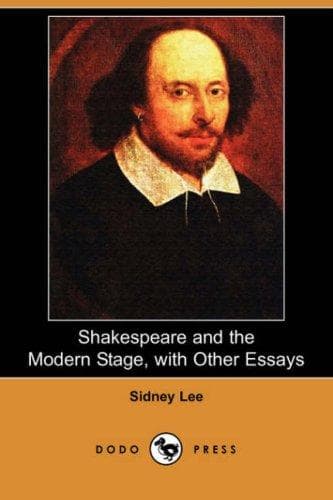
Shakespeare and the Modern Stage; with Other EssaysLee, Sidney, Sir
History
Shakespeare and the Modern Stage; with Other Essays
Lee, Sidney, Sir
Shakespeare, William, 1564-1616; Shakespeare, William, 1564-1616 -- Stage history
Though mean and mighty, rotting
Together, make one dust; yet reverence,--
That angel of the world,--doth make distinction
Of place 'twixt high and low.
"Reverence, that angel of the world," is the ultimate bond of civil
society, and can never be defied with impunity, it is the saving
sanction of social order.
V
I have quoted some of Shakespeare's avowedly ethical utterances which
bear on conditions of civil society--on morals in their social aspect.
There is no obscurity about their drift. Apart from direct ethical
declaration, it may be that ethical lessons touching political virtue
as well as other specific aspects of morality are deducible from a
study of Shakespeare's plots and characters. Very generous food for
reflection seems to be offered the political philosopher by the plots
and characters of _Julius Caesar_ and _Coriolanus_. The personality of
Hamlet is instinct with ethical suggestion. The story and personages
of _Measure for Measure_ present the most persistent of moral
problems. But discussion of the ethical import of Shakespeare's
several dramatic portraits or stories is of doubtful utility. There is
a genuine danger of reading into Shakespeare's plots and characters
more direct ethical significance than is really there. Dramatic art
never consciously nor systematically serves obvious purposes of
morality, save to its own detriment.
Nevertheless there is not likely to be much disagreement with the
general assertion that Shakespeare's plots and characters
involuntarily develop under his hand in conformity with the
straightforward requirements of moral law. He upholds the broad canons
of moral truth with consistency, even with severity. There is no
mistaking in his works on which side lies the right. He never renders
vice amiable. His want of delicacy, his challenges of modesty, need
no palliation. It was characteristic of his age to speak more plainly
of many topics about which polite lips are nowadays silent. But
Shakespeare's coarsenesses do no injury to the healthy-minded. They do
not encourage evil propensities. Wickedness is always wickedness in
Shakespeare, and never deludes the spectator by masquerading as
something else. His plays never present problems as to whether vice is
not after all in certain conditions the sister of virtue. Shakespeare
never shows vice in the twilight, nor leaves the spectator or reader
in doubt as to what its features precisely are. Vice injures him who
practises it in the Shakespearean world, and ultimately proves his
ruin. One cannot play with vice with impunity.
The gods are just, and of our pleasant vices
Make instruments to plague us.
It is not because Shakespeare is a conscious moralist, that the wheel
comes full circle in his dramatic world. It is because his sense of
art is involuntarily coloured by a profound conviction of the ultimate
justice which governs the operations of human nature and society.
Public-domain text, read in full here on John Shaqi.
Reviews
Reviews
No reviews yet
Be the first to share your thoughts on this work.
Elsewhere in the archive
Join the Discussion
Join the discussion
Sign in to leave a comment or review.
Sign InorCreate an account