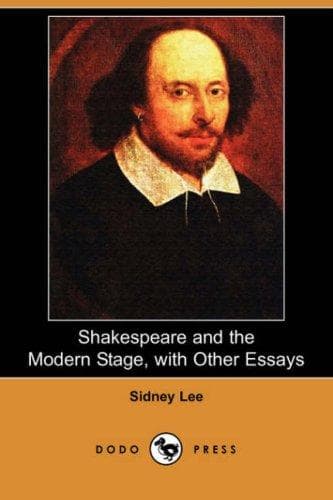
Shakespeare and the Modern Stage; with Other EssaysLee, Sidney, Sir
History
Shakespeare and the Modern Stage; with Other Essays
Lee, Sidney, Sir
Shakespeare, William, 1564-1616; Shakespeare, William, 1564-1616 -- Stage history
In Shakespeare's universal survey of human nature it was impossible
that he should leave patriotism and the patriotic instinct out of
account. It was inevitable that prevalent phases of both should
frequently occupy his attention. In his role of dramatist he
naturally dealt with the topic incidentally or disconnectedly rather
than in the way of definite exposition; but in the result, his
treatment will probably be found to be more exhaustive than that of
any other English writer. The Shakespearean drama is peculiarly
fertile in illustration of the virtuous or beneficent working of the
patriotic instinct; but it does not neglect the malevolent or morbid
symptoms incident either to its exorbitant or to its defective growth;
nor is it wanting in suggestions as to how its healthy development may
be best ensured. Part of Shakespeare's message on the subject is so
well known that readers may need an apology for reference to it; but
Shakespeare's declarations have not, as far as I know, been
co-ordinated.[34]
[Footnote 34: In passing cursorily over the whole field I must ask
pardon for dwelling occasionally on ground that is in detached detail
sufficiently well trodden, as well as for neglecting some points which
require more thorough exploration than is practicable within my
present limits.]
Broadly speaking, the Shakespearean drama enforces the principle that
an active instinct of patriotism promotes righteous conduct. This
principle lies at the root of Shakespeare's treatment of history and
political action, both English and Roman. Normal manifestations of the
instinct in Shakespeare's world shed a gracious light on life. But it
is seen to work in many ways. The patriotic instinct gives birth to
various moods. It operates with some appearance of inconsistency. Now
it acts as a spiritual sedative, now as a spiritual stimulant.
Of all Shakespeare's characters, it is Bolingbroke in _Richard II._
who betrays most effectively the tranquillising influence of
patriotism. In him the patriotic instinct inclines to identity with
the simple spirit of domesticity. It is a magnified love for his own
hearthstone--a glorified home-sickness. The very soil of England,
England's ground, excites in Bolingbroke an overmastering sentiment of
devotion. His main happiness in life resides in the thought that
England is his mother and his nurse. The patriotic instinct thus
exerts on a character which is naturally cold and unsympathetic a
softening, soothing, and purifying sway. Despite his forbidding
self-absorption and personal ambition he touches hearts, and rarely
fails to draw tears when he sighs forth the bald lines:--
Where'er I wander, boast of this I can,
Though banished, yet a true-born Englishman.
Public-domain text, read in full here on John Shaqi.
Reviews
Reviews
No reviews yet
Be the first to share your thoughts on this work.
Elsewhere in the archive
Join the Discussion
Join the discussion
Sign in to leave a comment or review.
Sign InorCreate an account