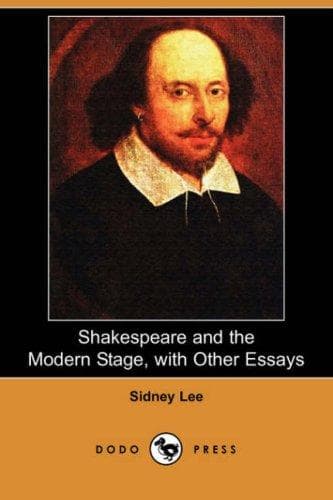
Shakespeare and the Modern Stage; with Other EssaysLee, Sidney, Sir
History
Shakespeare and the Modern Stage; with Other Essays
Lee, Sidney, Sir
Shakespeare, William, 1564-1616; Shakespeare, William, 1564-1616 -- Stage history
The appeal prevails, and the tribute is refused. Although the
evolution of the plot which is based on an historical chronicle
compels the renewed acquiescence of the British king in the Roman tax
at the close of the play, the Queen of Britain's spirited insistence
on the maritime strength of her country loses little of its
significance.
IV
Frank criticism of the social life of the nation is as characteristic
of Shakespearean drama as outspoken exposition of its political
failings. There is hardly any of Shakespeare's plays which does not
offer shrewd comment on the foibles and errors of contemporary English
society.
To society, Shakespeare's attitude is that of a humorist who invites
to reformation half-jestingly. His bantering tone, when he turns to
social censure, strikingly contrasts with the tragic earnestness that
colours his criticism of political vice or weakness. Some of the
national failings on the social side which Shakespeare rebukes may
seem trivial at a first glance. But it is the voice of prudent
patriotism which prompts each count in the indictment. The keenness of
Shakespeare's insight is attested by the circumstance that every
charge has a modern application. None is yet quite out of date.
Shakespeare rarely missed an opportunity of betraying contempt for the
extravagances of his countrymen and countrywomen in regard to dress.
Portia says of her English suitor Faulconbridge, the young baron of
England: "How oddly he is suited! I think he bought his doublet in
Italy, his round hose in France, his bonnet in Germany, and his
behaviour everywhere." Another failing in Englishmen, which Portia
detects in her English suitor, is a total ignorance of any language
but his own. She, an Italian lady, remarks: "You know I say nothing to
him, for he understands not me nor I him. He hath neither Latin,
French, nor Italian. He is a proper man's picture, but, alas! who can
converse with a dumb show." This moving plaint draws attention to a
defect which is not yet supplied. There are few Englishmen nowadays
who, on being challenged to court Portia in Italian, would not cut a
sorry figure in dumb show--sorrier figures than Frenchmen or Germans.
No true patriot ought to ignore the fact or to direct attention to it
with complacency.
Again, Shakespeare was never unmindful of the drunken habits of
his compatriots. When Iago sings a verse of the song beginning,
"And let me the cannikin clink," and ending, "Why then let a
soldier drink," Cassio commends the excellence of the ditty.
Thereupon Iago explains: "I learned it in England, where indeed
they are most potent in potting; Your Dane, your German, and
your swag-bellied Hollander--drink, ho!--are nothing to your
English." Cassio asks: "Is your Englishman so expert in his drinking?"
Iago retorts: "Why, he drinks you, with facility, your Dane dead
drunk," and gains, the speaker explains, easy mastery over the German
and the Hollander.
Public-domain text, read in full here on John Shaqi.
Reviews
Reviews
No reviews yet
Be the first to share your thoughts on this work.
Elsewhere in the archive
Join the Discussion
Join the discussion
Sign in to leave a comment or review.
Sign InorCreate an account