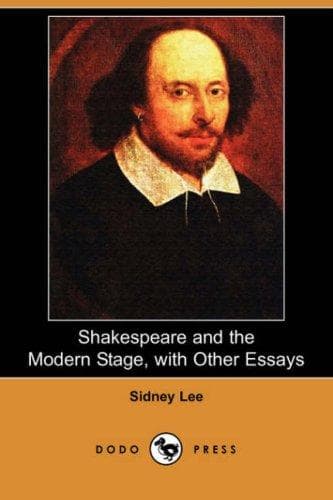
Shakespeare and the Modern Stage; with Other EssaysLee, Sidney, Sir
History
Shakespeare and the Modern Stage; with Other Essays
Lee, Sidney, Sir
Shakespeare, William, 1564-1616; Shakespeare, William, 1564-1616 -- Stage history
Unfortunately for this neglected intelligence, the letter in question
is an eighteenth century fabrication. It is a forgery of no intrinsic
brilliance or wit. It bears on its dull face marks of guilt which
could only escape the notice of the uninformed. It is not likely to
mislead the critical. Nevertheless it has deceived many an uncritical
reader, and has constantly found its way into print without meeting
serious confutation. It may therefore be worth while setting its true
origin and subsequent history on record. No endeavour is likely in all
the circumstances of the case to prevent an occasional resurrection of
the meagre spectre; but at present it appears to walk in various
quarters quite unimpeded, and an endeavour to lay it may not be
without its uses.
II
Through the first half of 1763 there was published in London a monthly
magazine called the _Theatrical Review, or Annals of the Drama_, an
anonymous miscellany of dramatic biography and criticism. It was a
colourless contribution to the journalism of the day, and lacked
powers of endurance. It ceased at the end of six months. The six
instalments were re-issued as "Volume I." at the end of June 1763; but
that volume had no successor.[39]
[Footnote 39: Other independent publications of similar character
appeared under the identical title of _The Theatrical Review_ both in
1758 and 1772. The latter collected the ephemeral dramatic criticisms
of John Potter, a well-known writer for the stage.]
All that is worth noting of the _Theatrical Review_ of 1763 now is
that among its contributors was an extremely interesting personality.
He was a young man of good education and independent means, who had
chambers in the Temple, and was enthusiastically applying himself to a
study of Shakespeare and Elizabethan dramatic literature. His name,
George Steevens, acquired in later years world-wide fame as that of
the most learned of Shakespearean commentators. Of the real value of
Steevens's scholarship no question is admissible, and his reputation
justly grew with his years. Yet Steevens's temper was singularly
perverse and mischievous. His confidence in his own powers led him to
contemn the powers of other people. He enjoyed nothing so much as
mystifying those who were engaged in the same pursuits as himself, and
his favourite method of mystification was to announce anonymously the
discovery of documents which owed all their existence to his own
ingenuity. This, he admitted, was his notion of "fun." Whenever the
whim seized him, he would in gravest manner reveal to the Press, or
even contrive to bring to the notice of a learned society, some
alleged relic in manuscript or in stone which he had deliberately
manufactured. His sole aim was to recreate himself with laughter at
the perplexity that such unholy pranks aroused. It is one of these
Puck-like tricks on Steevens's part that has spread confusion among
those of my correspondents, who allege that Peele has handed down to
Public-domain text, read in full here on John Shaqi.
Reviews
Reviews
No reviews yet
Be the first to share your thoughts on this work.
Elsewhere in the archive
Join the Discussion
Join the discussion
Sign in to leave a comment or review.
Sign InorCreate an account