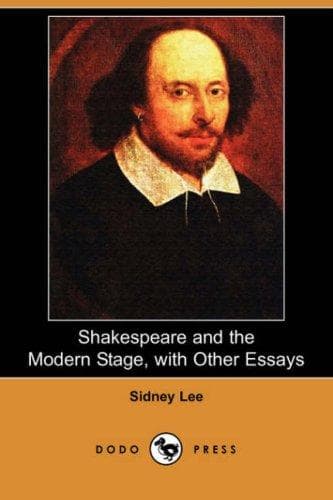
Shakespeare and the Modern Stage; with Other EssaysLee, Sidney, Sir
History
Shakespeare and the Modern Stage; with Other Essays
Lee, Sidney, Sir
Shakespeare, William, 1564-1616; Shakespeare, William, 1564-1616 -- Stage history
Then it was very gradually that Shakespeare's pre-eminence was
realised by French critics. It is to Voltaire that Frenchmen owe a
full knowledge of Shakespeare. Voltaire's method of teaching
Shakespeare to his countrymen was characteristically cynical. He
studied him closely when he visited England as a young man. At that
period of his career he not merely praised him with discerning
caution, but he paid him the flattery of imitation. Voltaire's tragedy
of _Brutus_ betrays an intimate acquaintance with Shakespeare's
_Julius Caesar_. His _Eryphile_ was the product of many perusals of
_Hamlet_. His _Zaire_ is a pale reflection of _Othello_. But when
Voltaire's countrymen showed a tendency to better Voltaire's
instruction, and one Frenchman conferred on Shakespeare the title of
"the god of the theatre," Voltaire resented the situation that he had
himself created. He was at the height of his own fame, and he felt
that his reputation as the first of French writers for the stage was
in jeopardy.
The last years of Voltaire's life were therefore consecrated to an
endeavour to dethrone the idol which his own hands had set up.
Voltaire traded on the patriotic prejudices of his hearers, but his
efforts to depreciate Shakespeare were very partially successful. Few
writers of power were ready to second the soured critic, and after
Voltaire's death the Shakespeare cult in France, of which he was the
unwilling inaugurator, spread far and wide.
In the nineteenth century Shakespeare was admitted without demur into
the French "pantheon of literary gods." Classicists and romanticists
vied in doing him honour. The classical painter Ingres introduced his
portrait into his famous picture of "Homer's Cortege" (now in the
Louvre). The romanticist Victor Hugo recognised only three men as
memorable in the history of humanity, and Shakespeare was one of the
three; Moses and Homer were the other two. Alfred de Musset became a
dramatist under Shakespeare's spell. To George Sand everything in
literature seemed tame by the side of Shakespeare's poetry. The prince
of romancers, the elder Dumas, set the English dramatist next to God
in the cosmic system; "after God," wrote Dumas, "Shakespeare has
created most."
III
It would be easy to multiply eulogies of Shakespeare from French lips
in the vein of Victor Hugo and Dumas--eulogies besides which the
enthusiasm of many English critics appears cold and constrained. So
unfaltering a note of admiration sounds gratefully in the ears of
Shakespeare's countrymen. Yet on closer investigation there seems a
rift within the lute. When one turns to the French versions of
Shakespeare, for which the chief of Shakespeare's French encomiasts
have made themselves responsible, an Englishman is inclined to
moderate his exultation in the French panegyrics.
Public-domain text, read in full here on John Shaqi.
Reviews
Reviews
No reviews yet
Be the first to share your thoughts on this work.
Elsewhere in the archive
Join the Discussion
Join the discussion
Sign in to leave a comment or review.
Sign InorCreate an account