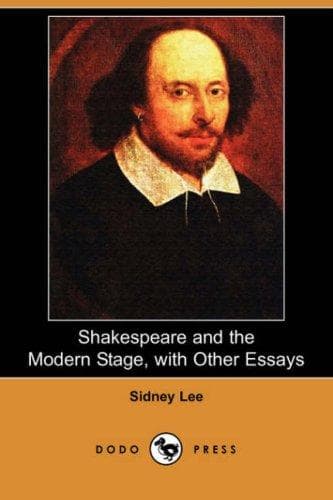
Shakespeare and the Modern Stage; with Other EssaysLee, Sidney, Sir
History
Shakespeare and the Modern Stage; with Other Essays
Lee, Sidney, Sir
Shakespeare, William, 1564-1616; Shakespeare, William, 1564-1616 -- Stage history
Apart from the practical difficulties of realising materially
Shakespeare's local associations with London, it is doubtful if the
mere commemoration in London of Shakespeare's personal connection with
the great city ought to be the precise aim of those who urge the
propriety of erecting a national monument in the metropolis.
Shakespeare's personal relations with London can in all the
circumstances of the case be treated as a justification in only the
second degree. The primary justification involves a somewhat different
train of thought. A national memorial of Shakespeare in London must be
reckoned of small account if it merely aim at keeping alive in public
memory episodes of Shakespeare's London career. The true aim of a
national London memorial must be symbolical of a larger fact. It must
typify Shakespeare's place, not in the past, but in the present life
of the nation and of the world. It ought to constitute a perpetual
reminder of the position that he fills in the present economy, and is
likely to fill in the future economy of human thought, for those whose
growing absorption in the narrowing business of life tends to make
them forget it.
The day is long since past when vague eulogy of Shakespeare is
permissible. Shakespeare's literary supremacy is as fully recognised
by those who justly appreciate literature as any law of nature. To the
man and woman of culture in all civilised countries he symbolises the
potency of the human intellect. But those who are content to read and
admire him in the cloister at times overlook the full significance of
his achievement in the outer world. Critics of all nationalities are
in substantial agreement with the romance-writer Dumas, who pointed
out that Shakespeare is more than the greatest of dramatists; he is
the greatest of thinking men.
The exalted foreign estimate illustrates the fact that Shakespeare
contributes to the prestige of his nation a good deal beyond repute
for literary power. He is not merely a literary ornament of our
British household. It is largely on his account that foreign nations
honour his country as an intellectual and spiritual force. Shakespeare
and Newton together give England an intellectual sovereignty which
adds more to her "reputation through the world" than any exploit in
battle or statesmanship. If, again, Shakespeare's pre-eminence has
added dignity to the name of Englishman abroad, it has also quickened
the sense of unity among the intelligent sections of the
English-speaking peoples. Admiration, affection for his work has come
to be one of the strongest links in the chain which binds the
English-speaking peoples together. He quickens the fraternal sense
among all who speak his language.
Public-domain text, read in full here on John Shaqi.
Reviews
Reviews
No reviews yet
Be the first to share your thoughts on this work.
Elsewhere in the archive
Join the Discussion
Join the discussion
Sign in to leave a comment or review.
Sign InorCreate an account