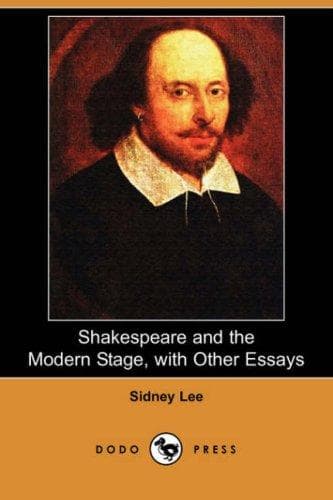
Shakespeare and the Modern Stage; with Other EssaysLee, Sidney, Sir
History
Shakespeare and the Modern Stage; with Other Essays
Lee, Sidney, Sir
Shakespeare, William, 1564-1616; Shakespeare, William, 1564-1616 -- Stage history
London is no nominal capital of the kingdom and the Empire. It is the
headquarters of British influence. Within its boundaries are assembled
the official insignia of British prestige. It is the mother-city of
the English-speaking world. To ask of the citizens of London some
outward sign that Shakespeare is a living source of British prestige,
an unifying factor in the consolidation of the British Empire, and a
powerful element in the maintenance of fraternal relations with the
United States, seems therefore no unreasonable demand. Neither
cloistered study of his plays, nor the occasional representation of
them in the theatres, brings home to either the English-speaking or
the English-reading world the full extent of the debt that England
owes to Shakespeare. A monumental memorial, which should symbolise
Shakespeare's influence in the universe, could only find an
appropriate and effective home in the capital city of the British
Empire. It is this conviction, and no narrower point of view, which
gives endeavour to commemorate Shakespeare in London its title to
consideration.
VII
The admitted fact that Shakespeare's fame is established beyond risk
of decay does not place him outside the range of conventional methods
of commemoration. The greater a man's recognised service to his
fellows, the more active grows in normally constituted minds that
natural commemorative instinct, which seeks outward and tangible
expression. A strange fallacy underlies the objection that has been
taken to any commemoration of Shakespeare on the alleged ground that
Milton warned the English people of all time against erecting a
monument to Shakespeare.
In 1630 Milton asked the question that is familiar to thousands of
tongues:
What needs my Shakespeare for his honoured bones?
By way of answer he deprecated any such "weak witness of his name" as
"piled stones" or "star-y-pointing pyramid." The poet-laureate of
England echoed Milton's sentiment in 1905. He roundly asserted that
"perishable stuff" is the fit crown of monumental pedestals. "Gods for
themselves," he concluded, "have monument enough." There are ample
signs that the sentiment to which Milton and the laureate give voice
has a good deal of public support.
None the less the poet-laureate's conclusion is clearly refuted by
experience and cannot terminate the argument. At any rate, in the
classical and Renaissance eras monumental sculpture was in habitual
request among those who would honour both immortal gods and mortal
heroes--especially mortal heroes who had distinguished themselves in
literature or art.
Public-domain text, read in full here on John Shaqi.
Reviews
Reviews
No reviews yet
Be the first to share your thoughts on this work.
Elsewhere in the archive
Join the Discussion
Join the discussion
Sign in to leave a comment or review.
Sign InorCreate an account