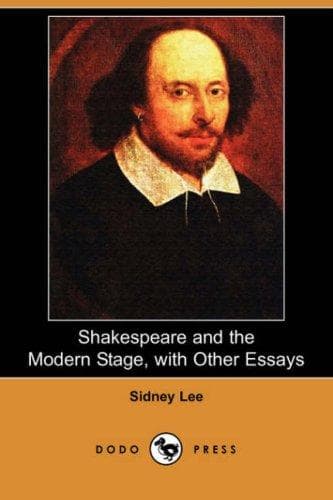
Shakespeare and the Modern Stage; with Other EssaysLee, Sidney, Sir
History
Shakespeare and the Modern Stage; with Other Essays
Lee, Sidney, Sir
Shakespeare, William, 1564-1616; Shakespeare, William, 1564-1616 -- Stage history
A little reflection will show, likewise, that Milton's fervid couplets
have small bearing on the question at issue in its present conditions.
Milton's poem is an elegy on Shakespeare. It was penned when the
dramatist had lain in his grave less that fourteen years, and when the
writer was in his twenty-second year. The exuberant enthusiasm of
youth was couched in poetic imagery which has from time immemorial
been employed in panegyrics of great poets. The beautiful figure which
presents a great man's work as his only lasting monument is as old as
poetry itself. The conceit courses through the classical poetry of
Greece from the time of Pindar, and through that of Italy from the
time of Ennius. No great Renaissance writer of modern Italy, of
sixteenth-century France, or of Elizabethan England, tired of arguing
that the poet's deathless memorial is that carved by his own pen.
Shakespeare himself clothed the conceit in glowing harmonies in his
sonnets. Ben Jonson, in his elegy on the dramatist, adapted the
time-honoured figure when he hailed his dead friend's achievement as
"a monument without a tomb."
"The truest poetry is the most feigning," and, when one recalls the
true significance and influence of great sculptured monuments through
the history of the civilised world, Milton's poetic argument can only
be accepted in what Sir Thomas Browne called "a soft and flexible
sense"; it cannot "be called unto the rigid test of reason." To treat
Milton's eulogy as the final word in the discussion of the subject
whether or no Shakespeare should have a national monument, is to come
into conflict with Sir Walter Scott, Tennyson, Ruskin, Dickens, and
all the greatest men of letters of the nineteenth century, who
answered the question in the affirmative. It is to discredit crowds of
admirers of great writers in classical and modern ages, who have
commemorated the labours of poets and dramatists in outward and
visible monuments.
The genius of the great Greek dramatists was not underrated by their
countrymen. Their literary efforts were adjudged to be true memorials
of their fame, and no doubt of their immortality was entertained. None
the less, the city of Athens, on the proposition of the Attic orator,
Lycurgus, erected in honour of AEschylus, Sophocles, and Euripides
statues which ranked with the most beautiful adornments of the Greek
capital. Calderon and Goethe, Camoens and Schiller, Sir Walter Scott
and Burns enjoy reputations which are smaller, it is true, than
Shakespeare's, but are, at the same time, like his, of both national
and universal significance. In memory of them all, monuments have been
erected as tokens of their fellow-countrymen's veneration and
gratitude for the influence which their poetry wields.
The fame of these men's writings never stood in any "need" of
monumental corroboration. The sculptured memorial testified to the
sense of gratitude which their writings generated in the hearts and
minds of their readers.
Public-domain text, read in full here on John Shaqi.
Reviews
Reviews
No reviews yet
Be the first to share your thoughts on this work.
Elsewhere in the archive
Join the Discussion
Join the discussion
Sign in to leave a comment or review.
Sign InorCreate an account