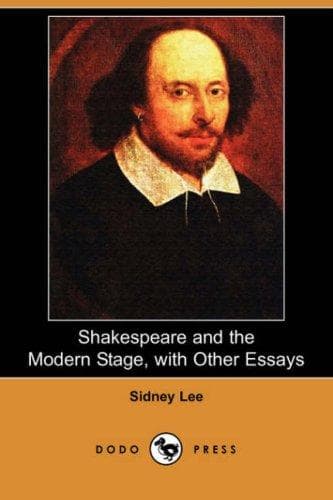
Shakespeare and the Modern Stage; with Other EssaysLee, Sidney, Sir
History
Shakespeare and the Modern Stage; with Other Essays
Lee, Sidney, Sir
Shakespeare, William, 1564-1616; Shakespeare, William, 1564-1616 -- Stage history
Although literature and art can flourish without royal favour and
royal patronage, still it is rare that royal patronage has any other
effect than that of raising those who are its objects in the
estimation of contemporaries. The interest that Shakespeare's work
excited at Court was continuous throughout his life. When James I.
ascended the throne, no author was more frequently honoured by
"command" performances of his plays in the presence of the sovereign.
And then, as now, the playgoer's appreciation was quickened by his
knowledge that the play they were witnessing had been produced before
the Court at Whitehall a few days earlier. Shakespeare's publishers
were not above advertising facts like these, as may be seen by a
survey of the title-pages of editions published in his lifetime. "The
pleasant conceited comedy called _Love's Labour's Lost_" was
advertised with the appended words, "as it was presented before her
highness this last Christmas." "A most pleasant and excellent
conceited comedy of _Sir John Falstaff and the Merry Wives of
Windsor_" was stated to have been "divers times acted both before her
majesty and elsewhere." The great play of _Lear_ was advertised, "as
it was played before the king's majesty at Whitehall on St Stephen's
night in the Christmas holidays."
V
Although Shakespeare's illimitable command of expression, his
universality of knowledge and insight, cannot easily be overlooked by
any man or woman of ordinary human faculty, still, from some points of
view, there is ground for surprise that the Elizabethan playgoer's
enthusiasm for Shakespeare's work was so marked and unequivocal as we
know that it was.
Let us consider for a moment the physical conditions of the theatre,
the methods of stage representation, in Shakespeare's day. Theatres
were in their infancy. The theatre was a new institution in social
life for Shakespeare's public, and the whole system of the theatrical
world came into being after Shakespeare came into the world. In
estimating Shakespeare's genius one ought to bear in mind that he was
a pioneer--almost the creator or first designer--of English drama, as
well as the practised workman in unmatched perfection. There were
before his day some efforts made at dramatic representation. The
Middle Ages had their miracle plays and moralities and interludes. But
of poetic, literary, romantic drama, England knew nothing until
Shakespeare was of age. Marlowe, who in his early years inaugurated
English tragedy, was Shakespeare's senior by only two months. It was
not till 1576, when Shakespeare was twelve, that London for the first
time possessed a theatre--a building definitely built for the purpose
of presenting plays. Before that year, inn-yards or platforms, which
were improvised in market-places or fields, served for the performance
of interludes or moralities.
Public-domain text, read in full here on John Shaqi.
Reviews
Reviews
No reviews yet
Be the first to share your thoughts on this work.
Join the Discussion
Join the discussion
Sign in to leave a comment or review.
Sign InorCreate an account