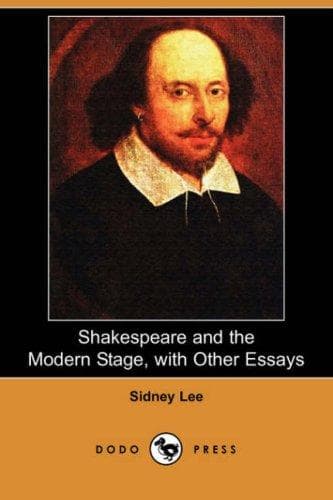
Shakespeare and the Modern Stage; with Other EssaysLee, Sidney, Sir
History
Shakespeare and the Modern Stage; with Other Essays
Lee, Sidney, Sir
Shakespeare, William, 1564-1616; Shakespeare, William, 1564-1616 -- Stage history
Although one could wish the early oral tradition of Stratford to have
been more thoroughly reported, such as is extant in writing is
sufficient to prove that Shakespeare's literary eminence was well
known in his native place during the century that followed his death.
In many villages in the neighbourhood of Stratford--at Bidford, at
Wilmcote, at Greet, at Dursley--there long persisted like oral
tradition of Shakespeare's occasional visits, but these were not
written down before the middle of the eighteenth century; and although
they are of service as proof of the local dissemination of his fame,
they are somewhat less definite than the traditions that suffered
earlier record, and need not be particularised here. One light piece
of gossip, which was associated with a country parish at some distance
from Stratford, can alone be traced back to remote date, and was
quickly committed to writing. A trustworthy Oxford don, Josias Howe,
fellow and tutor of Trinity, was born early in the seventeenth century
at Grendon in Buckinghamshire, where his father was long rector, and
he maintained close relations with his birthplace during his life of
more than ninety years. Grendon was on the road between Oxford and
London. Howe stated that Shakespeare often visited the place in his
journey from Stratford, and that he found the original of his
character of Dogberry in the person of a parish constable who lived on
there till 1642. Howe was on familiar terms with the man, and he
confided his reminiscence to his friend Aubrey, who duly recorded it,
although in a somewhat confused shape.
VII
It is with early oral tradition of Shakespeare's personal experience
that I am dealing here. It is not my purpose to notice early literary
criticism, of which there is abundant supply. It was obviously the
free circulation of the fame of Shakespeare's work which stimulated
the activity of interest in his private fortunes and led to the
chronicling of the oral tradition regarding them. It could easily be
shown that, outside the circle of professional poets, dramatists,
actors, and fellow-townsmen, Shakespeare's name was, from his first
coming into public notice, constantly on the lips of scholars,
statesmen, and men of fashion who had any glimmer of literary taste.
The Muse of History indeed drops plain hints of the views expressed at
the social meetings of the great in the seventeenth century when
Shakespeare was under discussion. Before 1643, "all persons of quality
that had wit and learning" engaged in a set debate at Eton in the
rooms of "the ever-memorable" John Hales, Fellow of the College, on
the question of Shakespeare's merits compared with those of classical
poets. The judges who presided over "this ingenious assembly"
unanimously and without qualification decided in favour of
Shakespeare's superiority.
Public-domain text, read in full here on John Shaqi.
Reviews
Reviews
No reviews yet
Be the first to share your thoughts on this work.
Elsewhere in the archive
Join the Discussion
Join the discussion
Sign in to leave a comment or review.
Sign InorCreate an account